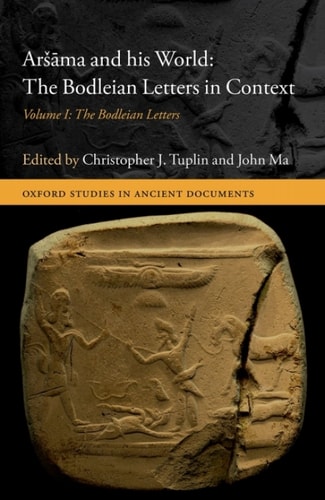
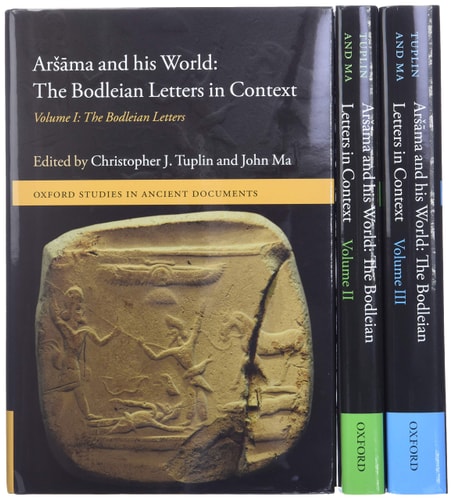
Aršāma and his World: The Bodleian Letters in Context: Volume I: The Bodleian Letters
0
0
As an Amazon Associate and affiliate partner, Menrva Books earns from qualifying purchases. Learn more
Author Description
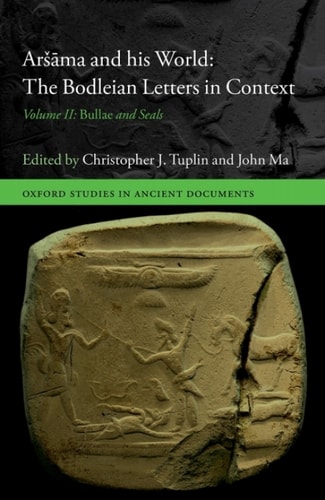
During the Second World War the Bodleian Library in Oxford acquired a set of Aramaic letters, eight sealings, and the two leather bags in which the sealed letters were once stored. The letters concern the affairs of Aršāma, satrap of Egypt in the later fifth century. Taken with other material associated with him (mostly in Aramaic, Demotic Egyptian, and Akkadian), they illuminate the Achaemenid world of which Aršāama was a privileged member and evoke a wide range of social, economic, cultural, organizational, and political perspectives, from multi-lingual communication, storage and disbursement of resources, and satrapal remuneration, to cross-regional ethnic movement, long-distance travel, religious practice, and iconographic projection of ideological messages. Particular highlights include a travel authorization (the only example of something implicit in numerous Persepolis documents), texts about the religious life of the Judaean garrison at Elephantine, Aršāma's magnificent seal (a masterpiece of Achaemenid glyptic, inherited from a son of Darius I), and echoes of temporary disturbances to Persian management of Egypt. But what is also impressive is the underlying sense of systematic coherence founded on and expressed in the use of formal, even formalized, written communication as a means of control. The Aršāma dossier is not alone in evoking that sense, but its size, variety, and focus upon a single individual give it a unique quality. Though this material has not been hidden from view, it has been insufficiently explored: it is the purpose of the three volumes of Aršāma and his World: The Bodleian Letters in Context to provide the fullest presentation and historical contextualization of this extraordinary cache yet attempted. Volume I presents and translates the letters alongside a detailed line-by-line commentary, while Volume II reconstructs the two seals that made the clay bullae that sealed the letters, with special attention to Aršāma's magnificent heirloo
Menrva's Summary
THE THESIS
This volume investigates the administrative and social mechanisms of the Achaemenid Empire through the primary source material of the Aršāma correspondence. Authors Christopher J. Tuplin and John Ma, both established scholars in ancient history and classical studies, utilize this cache of Aramaic letters to reconstruct the logistical and political realities of a fifth-century BCE satrap. The work argues that these documents reveal a highly formalized system of imperial control and cross-regional communication that defined the Persian management of Egypt.
THE SCOPE MAP
What You Will Find
- A complete presentation and translation of the Bodleian Aramaic letters.
- Detailed line-by-line philological and historical commentary.
- Analysis of satrapal resource management, travel authorization, and religious practices of the Judaean garrison.
- Examination of Achaemenid glyptic art and the iconography of power.
Scope Limits
- This volume focuses specifically on the textual content and historical context of the letters, leaving the detailed reconstruction of the physical seals for the subsequent volume.
THE AUTHORITY PERSPECTIVE
Scholars and historians regard this work as a foundational resource for the study of Achaemenid administrative practices and Aramaic epigraphy. Readers frequently note the academic density of the prose, which serves as a rigorous reference for specialists in ancient Near Eastern history.
Page Count:
480
Publication Date:
2020-01-01
Publisher:
OUP Oxford
ISBN-10:
0192652559
ISBN-13:
9780192652553
History
Persian Empire
Ancient History
Archaeology
Africa - History
Community Tags
Similar Books

Reader Comments
Share Your Thoughts
No comments yet. Be the first to share your thoughts!