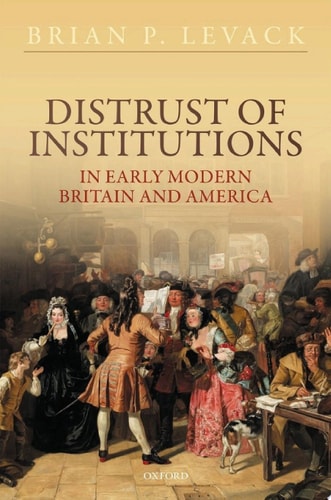
Distrust of Institutions in Early Modern Britain and America
0
0
As an Amazon Associate and affiliate partner, Menrva Books earns from qualifying purchases. Learn more
Author Description
Distrust of public institutions, which reached critical proportions in Britain and the United States in the first two decades of the twenty-first century, was an important theme of public discourse in Britain and colonial America during the early modern period. Demonstrating broad chronological and thematic range, the historian Brian P. Levack explains that trust in public institutions is more tenuous and difficult to restore once it has been betrayed than trust in one's family, friends, and neighbors, because the vast majority of the populace do not personally know the officials who run large national institutions. Institutional distrust shaped the political, legal, economic, and religious history of England, Scotland, and the British colonies in America. It provided a theoretical and rhetorical foundation for the two English revolutions of the seventeenth century and the American Revolution in the late eighteenth century. It also inspired reforms of criminal procedure, changes in the system of public credit and finance, and challenges to the clergy who dominated the Church of England, the Church of Scotland, and the churches in the American colonies. This study reveals striking parallels between the loss of trust in British and American institutions in the early modern period and the present day.
Menrva's Summary
THE THESIS
This work investigates the historical origins and manifestations of institutional distrust in Britain and colonial America during the early modern period. Brian P. Levack, a historian specializing in early modern Europe, utilizes a comparative historical framework to analyze how the erosion of public confidence in state, legal, and religious bodies functioned as a catalyst for political and social change. He argues that the impersonal nature of large-scale institutions makes them inherently more susceptible to crises of legitimacy than interpersonal relationships, a dynamic that remains relevant to contemporary political discourse.
THE SCOPE MAP
What You Will Find
- Analysis of the seventeenth-century English revolutions and the American Revolution.
- Examination of reforms in criminal procedure and public finance systems.
- Discussion of challenges to clerical authority within the Church of England and the Church of Scotland.
- Comparative study of institutional skepticism across Britain and its American colonies.
Scope Limits
- The study focuses primarily on the early modern period and does not provide a comprehensive analysis of modern institutional failures.
- The text does not cover non-British colonial experiences or non-Western institutional models.
THE AUTHORITY PERSPECTIVE
Scholars recognize this work as a significant contribution to the study of political culture and the historical roots of modern skepticism toward authority. Readers frequently note the academic rigor of the prose and the clarity with which Levack draws parallels between historical precedents and current societal trends.
Page Count:
352
Publication Date:
2022-01-01
Publisher:
OUP Oxford
ISBN-10:
0192663178
ISBN-13:
9780192663177
History
British History
Institutional Trust
American History
History - Modern
Sociology
History of the Americas