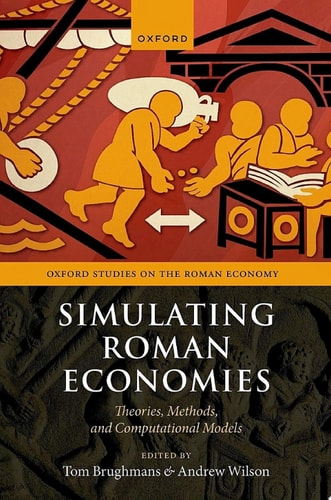
Simulating Roman Economies: Theories, Methods, and Computational Models
0
0
As an Amazon Associate and affiliate partner, Menrva Books earns from qualifying purchases. Learn more
Author Description
The use of formal modelling and computational simulation in studies of the Roman economy has become more common over the last decade. But detailed critical evaluations of this innovative approach are still missing and much needed. What kinds of insights about the Roman economy can it lead to that could not have been obtained through more established approaches, and how do simulation methods constructively enhance research processes in Roman Studies? This edited volume addresses this need through critical discussion and convincing examples. It presents the Roman economy as a highly complex system, traditionally studied through critical examinations of material and textual sources, and understood through a wealth of diverging theories. A key contribution of simulation lies in its ability to formally represent diverse theories of Roman economic phenomena, and test them against empirical evidence. Critical simulation studies rely on collaboration across Roman data, theory, and method specialisms, and can constructively enhance multivocality of theoretical debates of the Roman economy. This potential is illustrated, avoiding computational and mathematical language, through simulation studies of a wealth of Roman economic phenomena: from maritime trade and terrestrial transport infrastructures, through the economic impacts of the Antonine Plague and demography, to local cult economies and grain trade. Through these examples and discussions, this volume aims to provide the common ground, guidance, and inspiration needed to make simulation methods part of the tools of the trade in Roman Studies, and to allow them to make constructive contributions to our understanding of the Roman economy.
Menrva's Summary
THE THESIS
This volume investigates how formal computational modeling and simulation can provide new insights into the Roman economy that traditional textual and material analysis cannot achieve alone. Editor Tom Brughmans, a specialist in computational archaeology, brings together various contributors to argue that simulation serves as a bridge between diverse economic theories and empirical archaeological data. By representing complex systems through formal models, the book demonstrates how researchers can test hypotheses regarding Roman trade, infrastructure, and demographic shifts in a rigorous, reproducible manner.
THE SCOPE MAP
What You Will Find
- Methodological frameworks for integrating computational simulation into Roman historical research
- Case studies on maritime trade networks and terrestrial transport infrastructure
- Analysis of the economic impacts of the Antonine Plague and demographic fluctuations
- Investigations into local cult economies and grain distribution systems
Scope Limits
- The text avoids highly technical mathematical or computational code, focusing instead on conceptual application and theoretical integration
- It does not provide a comprehensive history of the Roman economy, but rather a methodological toolkit for studying it
THE AUTHORITY PERSPECTIVE
Experts identify this volume as a significant contribution to the growing field of computational archaeology and economic history. Readers frequently note that the text successfully bridges the gap between complex modeling techniques and traditional historical inquiry, making it a useful resource for scholars looking to incorporate digital methods into their research.
Page Count:
353
Publication Date:
2022-01-01
Publisher:
OUP Oxford
ISBN-10:
0192672436
ISBN-13:
9780192672438
History
Economics
Economics history
Roman Studies
Methodology
Archaeology
Community Tags
Similar Books