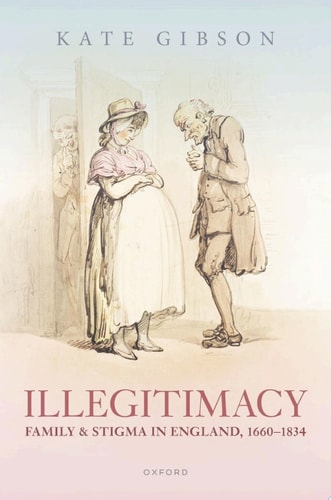
Illegitimacy, Family, and Stigma in England, 1660-1834
0
0
As an Amazon Associate and affiliate partner, Menrva Books earns from qualifying purchases. Learn more
Author Description
Illegitimacy, Family, and Stigma is the first full-length exploration of what it was like to be illegitimate in eighteenth-century England, a period of 'sexual revolution', unprecedented increase in illegitimate births, and intense debate over children's rights to state support. Using the words of illegitimate individuals and their families preserved in letters, diaries, poor relief, and court documents, this study reveals the impact of illegitimacy across the life cycle. How did illegitimacy affect children's early years, and their relationships with parents, siblings, and wider family as they grew up? Did illegitimacy limit education, occupation, or marriage chances? What were individuals' experiences of shame and stigma, and how did being illegitimate affect their sense of identity? Historian Kate Gibson investigates the circumstances that governed families' responses, from love and pragmatic acceptance, to secrecy and exclusion. In a major reframing of assumptions that illegitimacy was experienced only among the poor, this volume tells the stories of individuals from across the socio-economic scale, including children of royalty, physicians and lawyers, servants and agricultural labourers. It demonstrates that the stigma of illegitimacy operated along a spectrum, varying according to the type of parental relationship, the child's race, gender, and socio-economic status. Financial resources and the class-based ideals of parenthood or family life had a significant impact on how families reacted to illegitimacy. Class became more important over the eighteenth century, under the influence of Enlightenment ideals of tolerance, sensibility, and redemption. The child of sin was now recast as a pitiable object of charity, but this applied only to those who could fit narrow parameters of genteel tragedy. This vivid investigation of the meaning of illegitimacy gets to the heart of powerful inequalities in families, communities, and the state.
Menrva's Summary
THE THESIS
How did the experience of illegitimacy shape the lives, identities, and social standing of individuals in England between 1660 and 1834? Historian Kate Gibson examines the social and legal landscape of eighteenth-century England to determine how illegitimate status influenced life outcomes across various socio-economic strata. By analyzing primary source materials such as personal correspondence, court records, and poor relief documents, Gibson argues that stigma was not a uniform experience but a spectrum influenced by class, race, gender, and parental wealth. The study challenges the assumption that illegitimacy was exclusively a concern of the impoverished, demonstrating how Enlightenment ideals shifted the perception of illegitimate children from moral failures to objects of charitable concern.
THE SCOPE MAP
What You Will Find
- Analysis of the life cycle of illegitimate individuals from childhood through adulthood.
- Examination of the intersection between class-based ideals of family and the treatment of children born outside of marriage.
- Investigation into the influence of Enlightenment values on social attitudes toward illegitimacy.
Scope Limits
- The study is geographically confined to England.
- The research focuses specifically on the period between 1660 and 1834.
THE AUTHORITY PERSPECTIVE
Scholars recognize this work as a significant contribution to the social history of the family, particularly for its success in integrating the voices of the illegitimate into a broader historical framework. Readers frequently note the meticulous use of archival evidence to dismantle long-standing assumptions about the uniformity of social stigma during this era.
Page Count:
313
Publication Date:
2022-01-01
Publisher:
OUP Oxford
ISBN-10:
0192692828
ISBN-13:
9780192692825
History
Sociology
Special Topics
Family Studies
Social History
British History
Gender Studies
Community Tags
Other Editions(2)

Similar Books
Reader Comments
Share Your Thoughts
No comments yet. Be the first to share your thoughts!