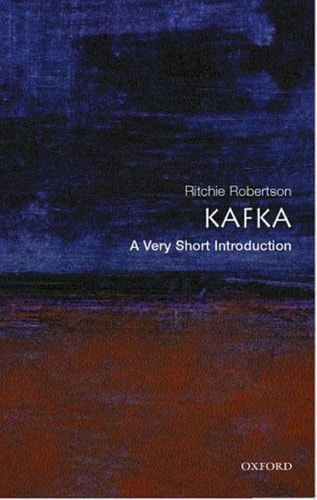
Kafka: A Very Short Introduction
0
0
As an Amazon Associate and affiliate partner, Menrva Books earns from qualifying purchases. Learn more
Author Description
Franz Kafka is among the most intriguing and influential writers of the last century. During his lifetime he worked as a civil servant and published only a handful of short stories, the best known being The Transformation. His other three novels, published after his death, helped to found his reputation as a uniquely perceptive interpreter of the twentieth century.Discussing both Kafka's crisis-ridden life and the subtleties of his art, Ritchie Robertson provides an intriguing and accessible look at the life of this fascinating author. Using Metamorphosis as a recurring example, Robertson shows how Kafka's work explores such characteristically modern themes as the place of the body in culture, the power of institutions over people, and the possibility of religion after Nietzsche had proclaimed "the death of God."
Menrva's Summary
THE THESIS
This work investigates the intersection of Franz Kafka’s personal life and his literary output to determine how his writing functions as a critique of twentieth-century modernity. Ritchie Robertson, a scholar of German literature, utilizes biographical data and textual analysis of Kafka’s major works to argue that the author’s narratives reflect profound anxieties regarding institutional power, the human body, and the crisis of faith in a post-Nietzschean world.
THE SCOPE MAP
What You Will Find
- Biographical overview of Kafka’s career as a civil servant and writer
- Analysis of major works including The Metamorphosis and his posthumous novels
- Examination of existential and theological themes in early twentieth-century literature
Scope Limits
- Does not provide an exhaustive chronological biography of every life event
- Focuses primarily on literary interpretation rather than comprehensive historical context of the Austro-Hungarian Empire
THE AUTHORITY PERSPECTIVE
Scholars and students frequently cite this text as a highly accessible entry point for understanding the complexities of Kafka’s prose. The consensus among critics is that Robertson successfully balances biographical detail with nuanced literary theory, making it a standard resource for those new to Kafka’s work.
Page Count:
136
Publication Date:
2005-01-01
Publisher:
Oxford University Press
ISBN-10:
0192804553
ISBN-13:
9780192804556
Non-Fiction
Philosophy
Biography
Authors Austrian
European
Literary Criticism