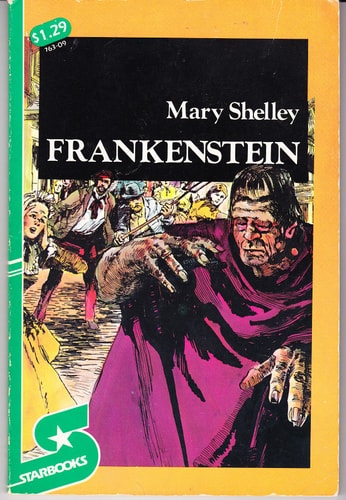
Frankenstein
0
0
As an Amazon Associate and affiliate partner, Menrva Books earns from qualifying purchases. Learn more
Author Description
To many readers, who have perhaps known Frankenstein only at second hand, the original may well come as a surprise. When Mary Shelley began it, she was only eighteen, though she was already Shelley's mistress and Byron's friend. In her preface she explains how she and Shelley spent part of a wet summer with Byron in Switzerland, amusing themselves by reading and writing ghost stories. Her contribution was Frankenstein, a story about a student of natural philosophy who learns the secret of imparting life to a creature constructed from bones he has collected in charnel-houses. The story is not a study of the macabre, as such, but rather a study of how man uses his power, through science, to manipulate and pervert his own destiny, and this makes it a profoundly disturbing book.
Menrva's Summary
THE PULSE
Victor Frankenstein, a brilliant student of natural philosophy, triggers a catastrophic chain of events when he succeeds in animating a creature constructed from human remains. Driven by an obsessive desire to unlock the secrets of life, Victor isolates himself from society to pursue his scientific ambition. He soon faces the consequences of his creation, as the creature, abandoned and rejected by its maker, seeks vengeance against Victor and his loved ones. The narrative employs an epistolary framework, utilizing letters and nested accounts to present the perspectives of Victor, the creature, and the explorer Robert Walton, creating a layered exploration of responsibility and isolation.
INSIDE THE PAGES
- Epistolary narrative structure using letters and journals
- Exploration of the ethics of scientific discovery
- Themes of alienation and social rejection
- Gothic atmosphere and bleak, desolate settings
- Philosophical inquiry into the nature of humanity
- Dual perspective between creator and creation
- Romantic era focus on the sublime and the natural world
- Examination of parental responsibility and abandonment
THE COLLECTIVE ECHO
Readers and critics frequently analyze the text as a foundational work that bridges the gap between Gothic horror and modern science fiction. Discussion often centers on the moral culpability of Victor Frankenstein and the inherent tragedy of the creature's search for belonging. Many highlight the effectiveness of the shifting narrative voices in humanizing the monster while simultaneously questioning the sanity of the scientist. The book remains a subject of intense academic debate regarding the dangers of unchecked ambition and the societal consequences of isolation. Scholars often point to the influence of the author's personal life and the intellectual climate of the early nineteenth century on the development of the plot.
Page Count:
270
Publication Date:
1982-08-26
Publisher:
Oxford University Press
ISBN-10:
0192815326
ISBN-13:
9780192815323
Science Fiction
Horror
Fiction - Horror
Philosophical
Scientists fiction
classic
Frankenstein fictitious character fiction
Gothic
Community Tags
Other Editions(55)

Independently Published
2020
Default edition
Editions Cosmopolites
2020

Sterling Publishing Company, Incorporated
2020

ReadHowYouWant.com, Limited
2020

Editora FTD S.A.
2019

Alma Books
2018
CreateSpace Independent Publishing Platform
2017

SC Active Business Development Srl
2017

Jazzybee Verlag
2015

Transatlantic Press
2015

Dover Publications, Incorporated
2013

Rarebooksclub.com
2012

Dalmatian Press
2011

Oxford University Press
2008

Evans Brothers
2007

Evans Brothers
2007
Sterling Publishing Company, Inc.
2006

1st World Library - Literary Society
2005

Townsend Press
2005

1st World Library
2004

ABDO Pub.
2002

Usborne
2002

Oxford Univ Pr
2001

Disonex
2001

Oxford University Press
2001

Express Publishing
2000

Ediciones SM
2000

Penguin Publishing Group
1999
Facts On File, Incorporated
1999

Wordsworth Editions Limited
1999

Savvas Learning Company
1998

Turtleback
1996

University of Virginia Library
1996

Laertes Editorial, S.L.
1994

Turtleback
1994

Ultramar
1994
Waldman Publishing Corporation
1993

Recorded Books/Borders
1993

H.M. Caldwell
1990

Édition du Rocher
1988

Tom Doherty Associates, LLC
1988

Bedrick/Blackie
1988
Alhambra
1986

Pearson
1986

Silver Burdett Press
1985

Hutchinson
1984
Oxford University Press
1982

Bantam Books
1981

Books on Tape
1980

Pendulum Press, Incorporated
1979

New American Library
1978

ReadHowYouWant.com
1973

Pendulum Press
1973

ReadHowYouWant.com
1965

Dell
1964
Similar Books









Reader Comments
Share Your Thoughts
No comments yet. Be the first to share your thoughts!