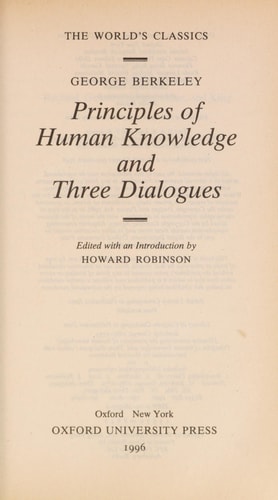
Principles of Human Knowledge and Three Dialogues
0
0
As an Amazon Associate and affiliate partner, Menrva Books earns from qualifying purchases. Learn more
Author Description
Berkeley's idealism started a revolution in philosophy. As one of the great empiricist thinkers he not only influenced British philosphers from Hume to Russell and the logical positivists in the twentieth-century, he also set the scene for the continental idealism of Hegel and even the philosophy of Marx. This edition of Berkeley's two key works has an introduction which examines and in part defends his arguments for idealism, as well as offering a detailed analytical contents list, extensive philosophical notes, and an index.
Menrva's Summary
THE THESIS
This work investigates the core philosophical question of whether material substance exists independently of human perception. George Berkeley, an influential 18th-century Irish philosopher, challenges the prevailing materialist assumptions of his era by arguing that objects are merely collections of ideas. Through these two foundational texts, he posits that 'to be is to be perceived,' establishing a rigorous framework for subjective idealism that directly influenced subsequent developments in Western thought.
THE SCOPE MAP
What You Will Find
- A systematic defense of immaterialism and the rejection of abstract ideas
- The application of empiricist principles to metaphysical problems
- Detailed analytical contents and extensive philosophical annotations
Scope Limits
- The text does not provide a comprehensive history of pre-Berkeleyan philosophy
- It does not address modern scientific developments in quantum mechanics or neuroscience
THE AUTHORITY PERSPECTIVE
Scholars and students of philosophy frequently identify this volume as a primary source for understanding the transition from classical empiricism to modern idealism. Readers often note the academic density of the prose, which requires careful engagement with Berkeley's specific logical arguments.
Page Count:
280
Publication Date:
1996-03-28
Publisher:
Oxford University Press
ISBN-10:
0192829734
ISBN-13:
9780192829733
Non-Fiction
Philosophy
Knowledge Theory
Idealism
Epistemology
Empiricism
Metaphysics
Community Tags
Other Editions(4)


Similar Books