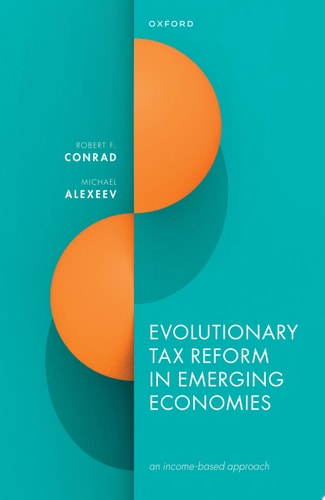
Evolutionary Tax Reform in Emerging Economies: An Income-Based Approach
0
0
As an Amazon Associate and affiliate partner, Menrva Books earns from qualifying purchases. Learn more
Author Description
One Approach To Tax Reform In Emerging Economies Is Developed In This Text. The Approach, Labelled Collection-driven Taxation Is Based On Three Elements: The Taxpayer Is Always The Individual; Compliance Is Enhanced By The Extensive Use Of Advanced Payments; And Suppliers Of Goods And Services, Other Than The Primary Inputs Of Capital And Labor, Serve As Advanced Payment Agents Who Withhold Or Collect Advanced Tax From Individual Taxpayers. Income Taxation, Valued Added Taxation, Excise Taxation, And Tariffs Are Supplemented By Small Business Taxation And Natural Resource Contracts, Where Relevant, And Are Coordinated To Develop An Initial Framework That Can Evolve Through Time Based On Experience, The Economy's Level Of Development, Administrative Capacity, And Public Understanding. The Intent Is To Enable The System To Evolve Through Time Via A Series Of Piecemeal Changes Until The Primary Revenue Source Is The Income Tax-- Provided By Publisher.
Menrva's Summary
THE THESIS
This text investigates how emerging economies can implement a sustainable, evolutionary framework for tax reform that transitions toward a primary reliance on income taxation. The authors, Michael Alexeev and Robert F. Conrad, utilize their expertise in public finance to propose a model termed 'collection-driven taxation.' This framework emphasizes administrative feasibility and incremental development, arguing that tax systems should adapt to an economy's specific level of development and institutional capacity over time.
THE SCOPE MAP
What You Will Find
- A detailed framework for collection-driven taxation using advanced payment agents.
- Integration strategies for income, value-added, excise, and small business taxes.
- Methodologies for coordinating natural resource contracts within a broader fiscal system.
Scope Limits
- The text does not provide a universal blueprint applicable to all political environments.
- It does not offer a comprehensive analysis of non-income-based tax alternatives.
THE AUTHORITY PERSPECTIVE
Experts recognize this work as a technical contribution to the field of fiscal policy in developing nations. Readers frequently note the pragmatic focus on administrative capacity as a key strength of the authors' proposed methodology.
Page Count:
400
Publication Date:
2024-01-01
Publisher:
Oxford University Press
ISBN-10:
0192847082
ISBN-13:
9780192847089
Economics
Politics
Economic Policy & Development
Public Policy
Taxation
Fiscal Policy
Emerging Economies
Community Tags
Similar Books