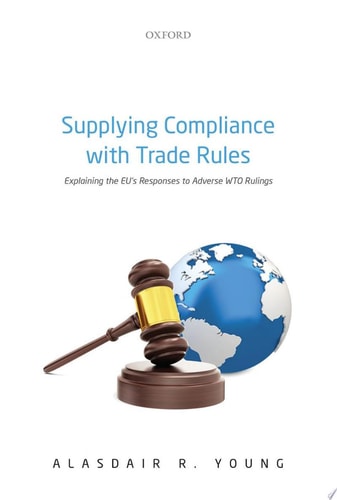
Supplying Compliance with Trade Rules: Explaining the EU's Responses to Adverse WTO Rulings
0
0
As an Amazon Associate and affiliate partner, Menrva Books earns from qualifying purchases. Learn more
Author Description
Trade agreements have become politicized in part because of public concerns that trade rules constrain regulatory decisions. How much international obligations constrain state behaviour, however, is contested in the International Relations literature.This book seeks to explain whether, why, and how jurisdictions comply with inconvenient international obligations. It does so through detailed process tracing of European Union (EU) policies found incompatible with World Trade Organization (WTO) rules: its ban on hormone-treated beef, its banana trade regime, its moratorium on the approval of genetically modified crops, its sugar export subsidies, and its anti-dumping duties on bed linen from India. It uses the adverse rulings as the 'treatment' in a 'natural experiment', contrasting the policy-relevant politics before and after each ruling. The case studies are supplemented by a qualitative comparative analysis of all EU policies found to contravene WTO rules that had to be changed by the end of 2019. The book contributes to debates on the impact of international institutions, on the effectiveness of the WTO, and on the nature of the EU as an international actor. It argues that the preferences of policy makers (the 'supply' of policy change) matter more than demands from societal actors in determining whether compliance occurs. It also argues that while policy change in response to adverse WTO rulings is the norm (good news for trade), WTO members do resist obligations that would compromise cherished policy objectives (good news for legitimacy). This volume contends that the EU's compliance performance is like that of most WTO members; it is not a unique international actor.
Menrva's Summary
THE THESIS
This book investigates the factors that determine whether, why, and how jurisdictions comply with inconvenient international trade obligations. Author Alasdair R. Young utilizes the European Union's responses to adverse World Trade Organization (WTO) rulings as a natural experiment to evaluate the influence of international institutions on state behavior. By contrasting policy-relevant politics before and after specific rulings, the work argues that the preferences of policymakers—the supply of policy change—are the primary drivers of compliance, rather than societal pressures.
THE SCOPE MAP
What You Will Find
- Detailed process tracing of five specific EU policy disputes involving hormone-treated beef, bananas, genetically modified crops, sugar export subsidies, and anti-dumping duties.
- A qualitative comparative analysis of all EU policies found to contravene WTO rules through the end of 2019.
- A theoretical framework assessing the impact of international institutions on state sovereignty and regulatory autonomy.
Scope Limits
- The analysis is restricted to the European Union's compliance record within the WTO framework.
- The study does not address compliance mechanisms in non-trade international agreements or organizations outside the WTO.
THE AUTHORITY PERSPECTIVE
Experts recognize this work as a significant contribution to the study of international institutions and the internal political dynamics of the European Union. Readers frequently note the academic rigor of the process tracing methodology and the clarity with which the author addresses the tension between international obligations and domestic policy objectives.
Page Count:
256
Publication Date:
2021-12-28
Publisher:
Oxford University Press
ISBN-10:
0192845616
ISBN-13:
9780192845610
Politics
World Trade Organization
International Trade
World politics
Public Policy
New Used & Rental Textbooks
International relations
European Union
Conflict of Laws
Community Tags
Similar Books