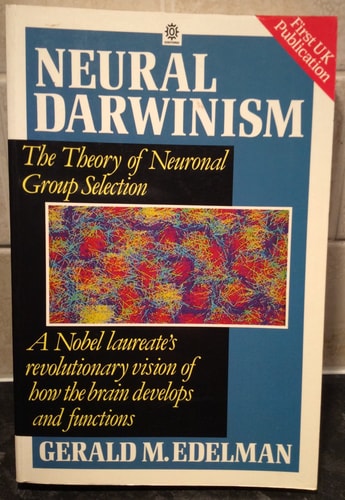
Neural Darwinism: The Theory of Neuronal Group Selection
0
0
As an Amazon Associate and affiliate partner, Menrva Books earns from qualifying purchases. Learn more
Author Description
This work presents a radical new view of the function of the brain and nervous system. It suggests that the nervous system in each individual operates as a selective system resembling natural selection in evolution but operating different mechanisms. By providing a fundamental neural basis for categorization of the things of the world it unifies perception, action and learning. This theory revises our view of memory, considering it as a dynamic process of recategorization which has implications for the various psychological states from attention to dreaming. It will stimulate discussion about the mind-body problem, the origins of knowledge and the perceptual bases of language. The author won the 1972 Nobel Prize for Physiology of Medicine.
Menrva's Summary
THE THESIS
How does the nervous system function as a selective system to organize perception, action, and learning? Gerald M. Edelman, a Nobel laureate in Physiology or Medicine, proposes the Theory of Neuronal Group Selection (TNGS). He argues that the brain does not function like a computer processing information, but rather as a selective system where neuronal groups compete and are reinforced based on environmental interaction, mirroring the principles of natural selection.
THE SCOPE MAP
What You Will Find
- The Theory of Neuronal Group Selection framework
- Mechanisms of somatic selection in the nervous system
- Models of memory as dynamic recategorization
- Integration of perception, action, and learning
Scope Limits
- Does not provide a comprehensive clinical manual for neurological disorders
- Does not address non-biological computational models of artificial intelligence
THE AUTHORITY PERSPECTIVE
Experts recognize this work as a foundational text in theoretical neuroscience that challenges traditional representationalist views of the brain. Readers frequently note the academic density of the prose, which requires a strong background in biological sciences to fully grasp the proposed mechanisms.
Page Count:
394
Publication Date:
1990-03-08
Publisher:
Oxford University Press
ISBN-10:
0192860895
ISBN-13:
9780192860897
Psychology
Biology
Neuroscience
Evolutionary Theory
Brain
Community Tags
Similar Books