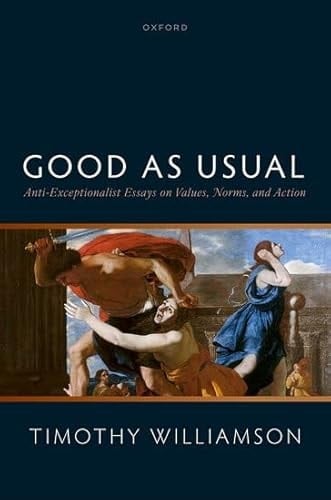
Author Description
When The Editors Of The Oxford Handbook Of Moral Realism, Paul Bloomfield And David Copp, Invited Me To Contribute A Chapter, I Hesitated. Although I Had Occasionally Dabbled In Metaethics And Metanormativity, As Several Chapters Of The Present Volume Show, I Have Certainly Never Claimed To Be A Metaethicist. Not That I Lack Metaethical Views Or Instincts: I Have Long Had An Outsider's Impression That Objections To Moral Realism Are Much Weaker Than They Are Usually Taken To Be. That Impression Comes Not From Any Special Attachment To Morality, But From An Attachment To Rigour In Logic And Semantics. Correspondingly, I Have Long Had Some Methodological Views About Metanormativity: In Particular, That The Philosophy Of Normative Language Is Best Done As Part Of General Philosophy Of Language, That The Epistemology Of Normative Knowledge Is Best Done As Part Of General Epistemology, And That The Metaphysics Of Normativity Is Best Done As Part Of General Metaphysics. In Each Case, The Application To Normativity Should Be Up To Date With Recent Theoretical Developments In The More General Field, And Meet Similar Standards Of Rigour, Systematicity, And Explicitnes
Menrva's Summary
THE THESIS
This collection investigates whether normative philosophy requires a unique methodology or if it should be integrated into the broader frameworks of logic, semantics, and metaphysics. Timothy Williamson, a prominent philosopher known for his work in epistemology and logic, argues that normative questions are best addressed by applying the same rigorous standards found in general philosophy. He contends that moral realism and other normative positions are often unfairly dismissed due to a lack of methodological integration with contemporary theoretical developments.
THE SCOPE MAP
What You Will Find
- Analysis of the relationship between normative language and general philosophy of language
- Application of formal logic and semantics to metaethical problems
- Critique of the tendency to treat normativity as an isolated field of inquiry
Scope Limits
- Does not provide a comprehensive history of moral realism
- Does not offer a prescriptive guide for moral decision-making
THE AUTHORITY PERSPECTIVE
Experts recognize this work as a significant methodological intervention that challenges the insularity of contemporary metaethics. Readers frequently note the technical density of the prose, which assumes a high level of familiarity with analytic philosophy and formal logic.
Page Count:
272
Publication Date:
2025-04-16
ISBN-10:
0192888870
ISBN-13:
9780192888877
Philosophy
Politics & Social Sciences
Metanormativity
Semantics
Epistemology
Logic
Metaphysics
Ethics & Morality
Metaethics