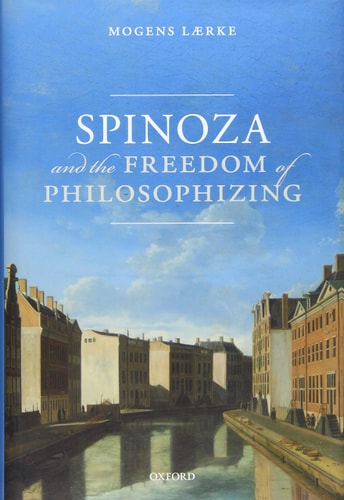
Spinoza and the Freedom of Philosophizing
0
0
As an Amazon Associate and affiliate partner, Menrva Books earns from qualifying purchases. Learn more
Author Description
Spinoza and the Freedom of Philosophizing is a study of freedom of speech, good government, civic responsibility, public education, and the foundations of religion and society, as seen through the eyes of seventeenth-century Dutch philosopher Spinoza. During the Golden Age of the Dutch Republic, a new kind of public sphere emerged. Courtly structures of political advice made room for new, republican forms of public consultation between the sovereign powers and the general citizenry. Missing, however, were guidelines for how and when to address questions of public concern and how to form unprejudiced citizens in possession of their own free judgment, capable of speaking up for themselves in public deliberations with the common interest in view. The book argues that Spinoza's conception of the freedom of philosophizing, and the systematic political theory he developed to defend it in his 1670 Theological-Political Treatise, were conceived to provide just such guidelines. It shows how Spinoza understood the freedom of philosophizing as a collective style of reasoning and argument based on mutual teaching and advising, a model for the public sphere in a free republic. It studies the conditions under which such a public sphere of free philosophizing could flourish, how it would require popular reform of public education and democratic reorganization of the relations between political counsel and sovereign command. It also shows how Spinoza designed theological and political doctrines of universal faith and social contract in order to promote true religion and a sense of civic duty, and asserted the state's right over sacred matters as a means to ensure mutual toleration in a multi-religious society.
Menrva's Summary
THE THESIS
This book investigates how Baruch Spinoza’s political theory, specifically his 1670 Theological-Political Treatise, establishes a framework for freedom of speech and civic responsibility within a democratic republic. Mogens Lærke, a scholar specializing in early modern philosophy, utilizes historical context from the Dutch Golden Age to analyze Spinoza’s arguments. The author posits that Spinoza’s work was not merely a defense of individual liberty, but a systematic proposal for a public sphere characterized by collective reasoning and mutual education. By examining the intersection of sovereign power and public deliberation, Lærke demonstrates how Spinoza sought to cultivate a citizenry capable of independent judgment.
THE SCOPE MAP
What You Will Find
- Analysis of the 1670 Theological-Political Treatise
- Examination of seventeenth-century Dutch political structures
- Theoretical framework for the relationship between public education and civic duty
- Discussion on the state's role in religious toleration
Scope Limits
- Does not provide a comprehensive biography of Spinoza
- Does not cover the entirety of Spinoza’s metaphysical works
THE AUTHORITY PERSPECTIVE
Scholars recognize this text as a rigorous contribution to the study of early modern political thought and the history of the public sphere. Readers frequently note the academic density of the prose, which is best suited for those already familiar with Spinoza’s primary texts and seventeenth-century political history.
Page Count:
400
Publication Date:
2021-04-25
Publisher:
Oxford University Press
ISBN-10:
0192895419
ISBN-13:
9780192895417
Philosophy
Philosophy history
Political Theory
Seventeenth Century
Dutch History
Community Tags
Similar Books