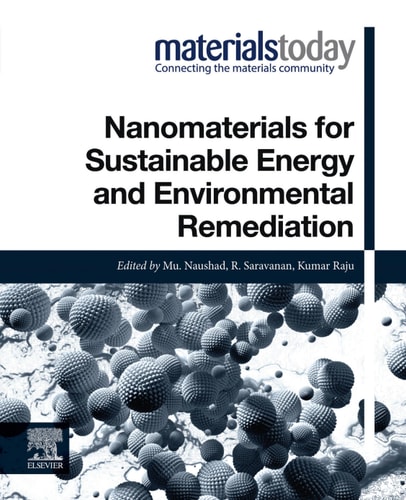
Nanomaterials for Sustainable Energy and Environmental Remediation
0
0
As an Amazon Associate and affiliate partner, Menrva Books earns from qualifying purchases. Learn more
Author Description
Nanostructured materials, especially, 1D, 2D and 3D nanostructures, and their engineered architectures are being increasingly used due to their potential to achieve sustainable development in energy and environmental sectors, providing a solution to a range of global challenges. A huge amount of research has been devoted in the recent past on the fine-tuning of nano-architecutres to accomplish innovations in energy storage and conversions, i.e., batteries, supercapacitors, fuel cells, solar cells, and electrochromic devices, bifunctional catalysts for ORR and OER, gas to fuels, liquid to fuels, and photocatalysts, corrosion, electrochemical sensors, and pollution and contaminants removal. Nanomaterials for Sustainable Energy and Environmental Remediation describes the fundamental aspects of a diverse range of nanomaterials for the sustainable development in energy and environmental remediation in a comprehensive manner. Experimental studies of varies nanomaterials will be discussed along with their design and applications, with specific attention to various chemical reactions involving and their challenges for catalysis, energy storage and conversion systems, and removal of pollutants are addressed. This book will also emphasise the challenges with past developments and direction for further research, details pertaining to the current ground - breaking technology and future perspective with multidisciplinary approach on energy, nanobiotechnology and environmental science Summarizes the latest advances in how nanotechnology is being used in energy and environmental science Outlines the major challenges to using nanomaterials for creating new products and devices in the sustainable energy and environmental sectors Helps materials scientists and engineers make selection and design decisions regarding which nanomaterial to use when creating new produts and evices for energy and environmental applications
Menrva's Summary
THE THESIS
This book investigates the critical role of nanostructured materials in addressing global challenges related to sustainable energy and environmental remediation. It details the design, synthesis, and application of various 1D, 2D, and 3D nanomaterials, exploring their use in energy storage and conversion devices such as batteries, supercapacitors, fuel cells, and solar cells. The text also covers their application as catalysts for crucial chemical reactions, in electrochemical sensors, and for the removal of pollutants and contaminants, providing a comprehensive overview of experimental studies and challenges.
THE SCOPE MAP
- Fundamental aspects of diverse nanomaterials for sustainable development in energy and environmental remediation.
- Experimental studies of various nanomaterials, including their design and applications.
- Detailed discussion of chemical reactions involving nanomaterials for catalysis, energy storage, and conversion systems.
- Addressing challenges in the removal of pollutants using nanomaterials.
- Emphasis on past developments, current ground-breaking technology, and future perspectives.
- Multidisciplinary approach integrating energy, nanobiotechnology, and environmental science.
- Latest advances in nanotechnology for energy and environmental science.
- Major challenges in using nanomaterials for sustainable energy and environmental products and devices.
THE AUTHORITY PERSPECTIVE
The book aims to provide a comprehensive understanding of nanomaterials for sustainable energy and environmental applications, detailing experimental studies, design principles, and challenges. It is structured to assist materials scientists and engineers in selecting and designing appropriate nanomaterials for new products and devices. The text emphasizes the integration of multidisciplinary approaches from energy, nanobiotechnology, and environmental science to tackle pressing global issues. It highlights recent advancements and outlines future research directions in this rapidly evolving field.
Page Count:
402
Publication Date:
2020-03-14
Publisher:
Elsevier S & T
ISBN-10:
0128193565
ISBN-13:
9780128193563
Science
Non-Fiction
Energy Conversion
Energy storage
Nanotechnology
Catalysis
Community Tags
Similar Books




Reader Comments
Share Your Thoughts
No comments yet. Be the first to share your thoughts!