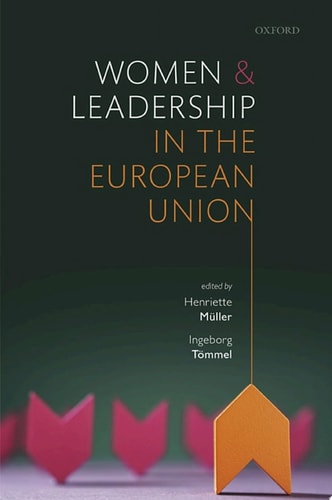
Women and Leadership in the European Union
0
0
As an Amazon Associate and affiliate partner, Menrva Books earns from qualifying purchases. Learn more
Author Description
This volume is the first comprehensive analysis of women's ascendance to leadership positions in the European Union as well as their performance in such positions. It provides a new theoretical and analytical framework capturing both positional and behavioural leadership and the specific hurdles that women encounter on their path to and when exercising leadership. The volume encompasses a detailed set of single and comparative case studies, analyzing women's representation and performance in the core EU institutions and their individual pathways to and exercise of power in top-level functions, as well as comparative analyses regarding the position and behaviour of women in relation to men. Based on these individual studies, the volume draws overarching conclusions about women's leadership in the EU. Regarding positional leadership, women continue to be underrepresented in leadership positions, they more often hold less prestigious portfolios in such positions, and manifold structural hurdles hamper their access to power. Furthermore, huge variations exist across EU institutions, with the intergovernmental bodies being the hardest to access. Regarding behavioural leadership, women acting in powerful EU positions generally perform excellently. They successfully exercise a combined leadership style that integrates attributes of leadership considered to be 'masculine' and 'feminine'. This is not to argue that women per se are the better leaders. Yet more often than men they are exposed to stronger selection processes and their prevalent practice of a combined leadership style tends to best meet the requirements of modern democratic systems and particularly those of the highly fragmented EU.
Menrva's Summary
THE THESIS
This volume investigates the factors influencing women's access to and performance within leadership roles across European Union institutions. Editors Henriette Müller and Ingeborg Tömmel utilize a dual-framework approach to evaluate both positional leadership—the attainment of high-level office—and behavioral leadership—the specific styles and strategies employed by women in power. The research synthesizes institutional data and individual case studies to determine how structural barriers and gendered expectations shape the political landscape of the EU.
THE SCOPE MAP
What You Will Find
- Comparative analysis of women's representation across core EU institutions
- A theoretical framework distinguishing between positional and behavioral leadership
- Empirical case studies examining individual career pathways to power
- Analysis of leadership styles, specifically the integration of masculine and feminine attributes
Scope Limits
- The study focuses primarily on formal EU institutional structures rather than grassroots political movements
- It does not provide a comprehensive history of European feminism, but rather focuses on contemporary professional leadership
THE AUTHORITY PERSPECTIVE
Scholars and political analysts identify this work as a foundational text for understanding the intersection of gender and institutional power within the European Union. Readers frequently note the academic density of the prose, which provides a rigorous, evidence-based examination of structural hurdles in modern democratic systems.
Page Count:
400
Publication Date:
2022-06-03
Publisher:
Oxford University Press
ISBN-10:
0192896210
ISBN-13:
9780192896216
Leadership
Public Policy
European Union
Gender Studies
Sociology
Community Tags
Similar Books