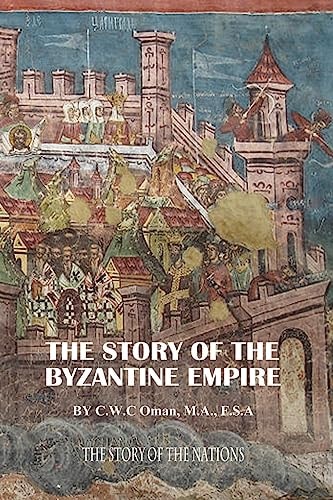
The Story of the Byzantine Empire
0
0
As an Amazon Associate and affiliate partner, Menrva Books earns from qualifying purchases. Learn more
Author Description
The Byzantine Empire, also referred to as the Eastern Roman Empire, was the continuation of the Roman Empire in the East during Late Antiquity and the Middle Ages, when its capital city was Constantinople (modern-day Istanbul, which had been founded as Byzantium). It survived the fragmentation and fall of the Western Roman Empire in the 5th century AD and continued to exist for an additional thousand years until it fell to the Ottoman Turks in 1453. During most of its existence, the empire was the most powerful economic, cultural, and military force in Europe. Both "Byzantine Empire" and "Eastern Roman Empire" are historiographical terms created after the end of the realm; its citizens continued to refer to their empire as the Roman Empire and to themselves as "Romans". Several signal events from the 4th to 6th centuries mark the period of transition during which the Roman Empire's Greek East and Latin West divided. Constantine I (r. 324-337) reorganised the empire, made Constantinople the new capital, and legalised Christianity. Under Theodosius I (r. 379-395), Christianity became the Empire's official state religion and other religious practices were proscribed. Finally, under the reign of Heraclius (r. 610-641), the Empire's military and administration were restructured and adopted Greek for official use instead of Latin. Thus, although the Roman state continued and Roman state traditions were maintained, modern historians distinguish Byzantium from ancient Rome insofar as it was centred on Constantinople, oriented towards Greek rather than Latin culture, and characterised by Orthodox Christianity. The borders of the Empire evolved significantly over its existence, as it went through several cycles of decline and recovery. During the reign of Justinian I (r. 527-565), the Empire reached its greatest extent after reconquering much of the historically Roman western Mediterranean coast, including North Africa, Italy, and Rome itself, which it held for two more centu
Menrva's Summary
THE THESIS
The Byzantine Empire represents the enduring legacy of the Roman Empire in its Eastern form, persisting for over a millennium after the fall of its Western counterpart. This empire, centered in Constantinople, was a dominant force in Europe, shaping its economic, cultural, and military landscape. Despite its citizens continuing to identify as "Romans," modern historians distinguish it by its Greek orientation, Orthodox Christianity, and its capital city. The narrative traces its evolution through key transitional periods, including Constantine I's reorganization and Theodosius I's establishment of Christianity as the state religion, culminating in Heraclius's adoption of Greek for official use.
THE SCOPE MAP
- The continuation of the Roman Empire in the East, known as the Byzantine Empire.
- The role of Constantinople as the capital city and its founding as Byzantium.
- The survival of the Eastern Roman Empire after the fall of the Western Roman Empire in the 5th century AD.
- The empire's status as a leading economic, cultural, and military power in Europe for most of its existence.
- Key transitional events from the 4th to 6th centuries, including Constantine I's reforms and Theodosius I's religious policies.
- The restructuring of the empire's military and administration under Heraclius and the adoption of Greek.
- The territorial evolution of the Empire, including Justinian I's reconquests.
THE AUTHORITY PERSPECTIVE
The provided description details the historical significance and evolution of the Byzantine Empire, focusing on its distinct identity from ancient Rome. It highlights key figures and events that shaped its trajectory, from its foundation to its eventual fall. The text emphasizes its role as a major European power and its cultural and religious characteristics. The description suggests a comprehensive historical account suitable for readers interested in the late Roman and medieval periods.
Page Count:
384
Publication Date:
2017-03-07
Publisher:
CreateSpace Independent Publishing Platform
ISBN-10:
1544218524
ISBN-13:
9781544218526
History
Non-Fiction
Late Antiquity
Middle Ages
Community Tags
Similar Books