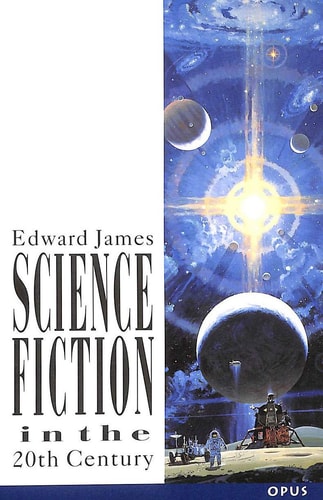
Science Fiction in the Twentieth Century
0
0
As an Amazon Associate and affiliate partner, Menrva Books earns from qualifying purchases. Learn more
Author Description
Science fiction is a cultural phenomenon. Its ideas and icons have permeated the imagery of cinema, television, rock music, and advertising; have come to dominate the world of play, from Ninja Turtles and transformer robots to comics and computer games; and have helped to create religions (like scientology) and popular delusions (like flying saucers). And for readers of science fiction it offers a different way of looking at the world, and a sense of community and of purpose.Science Fiction in the Twentieth Century is the first attempt to look beyond science fiction as a series of texts and authors, and to try to see it for what it is: a peculiarly twentieth-century genre. It is, as Edward James explains, a genre which endeavors to make sense of the effects of science and technology on our society, and a genre which by imagining other worlds allows us to view our own with greater detachment and perspective.James traces science fiction from 1895, the year of H.G. Wells's The Time Machine, through to its development as a distinct genre. He discusses the reasons behind the American domination of the field, which originated with John W. Campbell, Jr., the great editor of Astounding, and the first publisher of Isaac Asimov and Robert Heinlein. James goes on to look at the more recent emergence of a highly successful science fiction industry, and the way in which film, televsion, computer games, and children's toys have made science fiction ideas and imagery an important part of twentieth century culture.From H.G. Wells's The Time Machine and Grant Allen's The British Barbarians to Cyperpunk and beyond, Science Fiction in the Twentieth Century illuminates a rapidly evolving genre that includes everything from metaphysical philosophy to invading tomatoes.
Menrva's Summary
THE THESIS
How did science fiction evolve from a niche literary pursuit into a dominant cultural force that defines the twentieth-century experience? Edward James, a scholar of the genre, examines science fiction not merely as a collection of texts, but as a sociological phenomenon. He argues that the genre functions as a primary mechanism for society to process the rapid advancements of science and technology, utilizing speculative narratives to gain perspective on contemporary reality.
THE SCOPE MAP
What You Will Find
- A historical timeline beginning with H.G. Wells in 1895.
- Analysis of the American editorial influence, specifically the role of John W. Campbell, Jr.
- Exploration of the genre's expansion into film, television, gaming, and consumer products.
- Discussion of the transition from early speculative fiction to the emergence of the cyberpunk movement.
Scope Limits
- The text focuses primarily on the twentieth century and does not provide an exhaustive analysis of twenty-first-century digital-age developments.
- It does not serve as a comprehensive bibliography of every science fiction author, but rather as a thematic survey of the genre's cultural trajectory.
THE AUTHORITY PERSPECTIVE
Critics and scholars frequently cite this work as a foundational text for understanding the intersection of science fiction and twentieth-century cultural history. Readers often note that the prose is accessible yet academically rigorous, making it a standard reference for those interested in the evolution of speculative media.
Page Count:
272
Publication Date:
1994-12-15
Publisher:
Oxford University Press
ISBN-10:
0192892444
ISBN-13:
9780192892447
Non-Fiction
Literary Criticism
Science Fiction
Science History
Community Tags
Similar Books