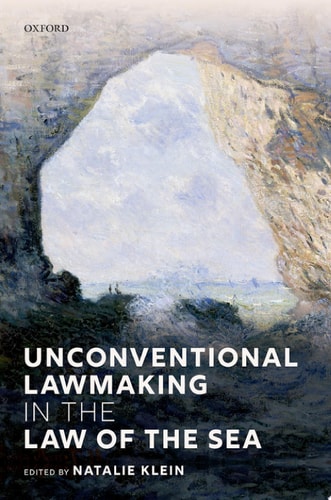
Unconventional Lawmaking in the Law of the Sea
0
0
As an Amazon Associate and affiliate partner, Menrva Books earns from qualifying purchases. Learn more
Author Description
Unconventional Lawmaking in the Law of the Sea explores the ways that actors operating at the international level develop standards of behaviour to regulate varied maritime activities beyond traditional lawmaking. Other than conventions and customary international law, there is a plethora of international agreements that influence international conduct. This 'soft law' or 'informal law' is now prolific in ocean governance, and so it is time to consider its significance for the law of the sea.This monograph brings together women law-of-the-sea scholars with expertise in specific areas of the law of the sea, as well as international law more generally. Informal lawmaking is examined in relation to ocean resources, maritime security, shipping and navigation, and the marine environment. In each instance, there are reflections on the diverse actors, processes, and outputs shaping the regulation of the oceans. The analyses in this book further consider what this activity means within the rules on the sources, formation, and interpretation of international law.The growing reliance on informal agreements to fill legal gaps provides quick responses to pressing matters. We must assess and understand these new forms of cooperation in order to influence existing treaties or customary international law. Unconventional Lawmaking in the Law of the Sea surveys the scope of informal lawmaking in the law of the sea and evaluates the significance of this activity for the UN Convention on the Law of the Sea, as well as for ocean governance more broadly, now and in the future.
Menrva's Summary
THE THESIS
This monograph investigates the proliferation of informal lawmaking and 'soft law' instruments in ocean governance and their subsequent impact on the traditional legal framework of the Law of the Sea. Natalie Klein, a professor with extensive expertise in international law, curates a collection of essays from prominent female scholars to analyze how non-traditional agreements influence maritime conduct. The text evaluates whether these flexible, rapid-response mechanisms complement or complicate the established UN Convention on the Law of the Sea.
THE SCOPE MAP
What You Will Find
- Analysis of informal lawmaking in maritime security and shipping
- Examination of regulatory processes for ocean resources and marine environmental protection
- Theoretical assessment of how soft law interacts with treaty formation and interpretation
Scope Limits
- Does not provide a comprehensive legal manual for maritime litigation
- Excludes detailed analysis of domestic maritime statutes outside of international contexts
THE AUTHORITY PERSPECTIVE
Legal scholars and practitioners identify this work as a significant contribution to the study of international legal sources and ocean governance. Readers frequently note the academic density of the prose, which serves as a specialized resource for those researching the evolution of international maritime regulation.
Page Count:
464
Publication Date:
2022-10-31
Publisher:
Oxford University Press
ISBN-10:
0192897829
ISBN-13:
9780192897824
Ocean Governance
Law
Maritime law
Law Of The Sea
International Law
Community Tags
Similar Books