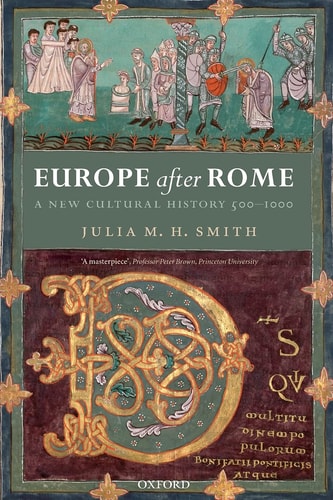
Europe after Rome: A New Cultural History, 500-1000
0
0
As an Amazon Associate and affiliate partner, Menrva Books earns from qualifying purchases. Learn more
Author Description
Europe after Rome: A New Cultural History 500-1000 is the first single-author study in more than fifty years to offer an integrated appraisal of the early Middle Ages as a dynamic and formative period in European history. Written in an attractive and accessible style, the book makes extensive use of original sources in order to introduce early medieval men and women at all levels of society--from slave to emperor--and allows them to speak to students in their own words. It overturns traditional narratives and instead offers an entirely fresh approach to the centuries from c.500 to c.1000.Rejecting any notion of a dominant, uniform early medieval culture, Europe after Rome argues that the fundamental characteristic of the early middle ages is diversity of experience. To explain how the men and women who lived in this period ordered their world in cultural, social, and political terms, it employs an innovative methodology that combines cultural history, regional studies, and gender history. Ranging comparatively from Ireland to Hungary and from Scotland and Scandinavia to Spain and Italy, the analysis highlights three themes: regional variation, power, and the legacy of Rome. In the context of debates about the social, religious, and cultural meaning of "Europe" in the early twenty-first century, this book seeks the origins of European cultural pluralism and diversity in the early Middle Ages.
Menrva's Summary
THE THESIS
This book investigates the early Middle Ages as a period defined by cultural pluralism and regional diversity rather than a monolithic or stagnant transition from the Roman Empire. Julia M. H. Smith, a scholar of early medieval history, utilizes a synthesis of primary source material and interdisciplinary methodology to challenge traditional historiography. By examining the lives of individuals across the social spectrum, she argues that the period between 500 and 1000 CE established the foundational patterns of European cultural variation and political organization.
THE SCOPE MAP
What You Will Find
- A comparative analysis spanning from Ireland and Scandinavia to Spain, Italy, and Hungary.
- An integrated methodology combining cultural, social, and gender history.
- Extensive use of primary source documents to provide voice to diverse social classes.
Scope Limits
- The text focuses primarily on cultural and social history rather than exhaustive military or economic chronologies.
- It does not attempt to provide a singular, unified narrative of the entire continent, emphasizing regional fragmentation instead.
THE AUTHORITY PERSPECTIVE
Historians and students frequently cite this work as a significant departure from older, more rigid interpretations of the early medieval period. The text is recognized for its accessibility and its success in integrating complex regional studies into a coherent cultural framework.
Page Count:
398
Publication Date:
2007-07-23
Publisher:
Oxford University Press, Usa
ISBN-10:
0192892630
ISBN-13:
9780192892638
History
Cultural History
Academic
European History
Community Tags
Similar Books