
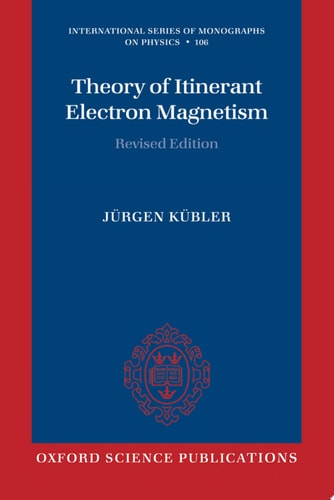
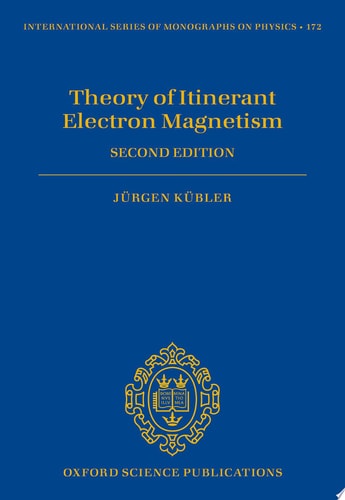
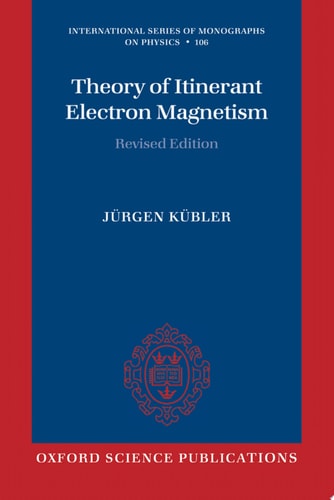
Theory of Itinerant Electron Magnetism
0
0
As an Amazon Associate and affiliate partner, Menrva Books earns from qualifying purchases. Learn more
Author Description
This book, in the broadest sense, is an application of quantum mechanics and statistical mechanics to the field of magnetism. Under certain well described conditions, an immensely large number of electrons moving in the solid will collectively produce permanent magnetism. Permanent magnets are of fundamental interest, and magnetic materials are of great practical importance as they provide a large field of technological applications. The physical details describing the many electron problem of magnetism are presented in this book on the basis of the density functional approximation. The emphasis is on realistic magnets, for which the equations describing properties of the many electron problem can only be solved by using computers. The significant recent and continuing improvements are, to a very large extent, responsible for the progress in this field.Along with an introduction to the density functional theory, the book describes representative computational methods and detailed formulas for physical properties of magnets which include among other things the computation of magnetic ordering temperatures, the giant magneto-resistance, magneto-optical effects, weak ferromagnetism, the anomalous Hall and Nernst effects, and novel quasiparticles, such as Weyl fermions and magnetic skyrmions.
Menrva's Summary
THE THESIS
This book investigates the application of quantum and statistical mechanics to explain the phenomenon of itinerant electron magnetism in solid materials. Jürgen Kübler, a physicist with extensive expertise in electronic structure calculations, utilizes density functional theory to address the many-electron problem. The text argues that realistic modeling of magnetic properties requires sophisticated computational methods to solve the complex equations governing electron behavior in solids.
THE SCOPE MAP
What You Will Find
- Density functional theory applications for magnetic systems
- Computational methodologies for calculating magnetic ordering temperatures
- Analysis of phenomena including giant magneto-resistance, magneto-optical effects, and the anomalous Hall effect
- Theoretical frameworks for novel quasiparticles such as Weyl fermions and magnetic skyrmions
Scope Limits
- The text assumes a high level of prior knowledge in quantum mechanics and solid-state physics
- It focuses primarily on computational approaches rather than experimental laboratory techniques
THE AUTHORITY PERSPECTIVE
Experts recognize this work as a rigorous technical reference for researchers and graduate students specializing in condensed matter physics. Readers frequently note the high mathematical density of the prose, which serves as a specialized resource for those engaged in computational materials science.
Page Count:
544
Publication Date:
2021-11-24
Publisher:
Oxford University Press
ISBN-10:
019289563X
ISBN-13:
9780192895639
Science
Computational Physics
Magnetism
Physics
Condensed Matter Physics
Community Tags
Other Editions(5)

Similar Books


Reader Comments
Share Your Thoughts
No comments yet. Be the first to share your thoughts!