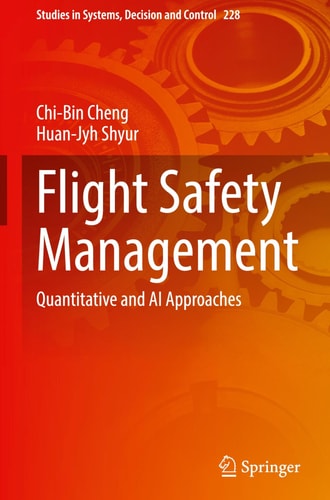
Flight Safety Management: Quantitative and AI Approaches
0
0
As an Amazon Associate and affiliate partner, Menrva Books earns from qualifying purchases. Learn more
Author Description
This book offers a comprehensive overview of using artificial intelligence and quantitative approaches in many phases of flight safety management, from proactive assessment of potential risks of flights before taking-off to automatic analysis of occurred flight events, for commercial airlines. Flight safety is commonly the core values of airlines. Serious flight disasters always bring tremendous impacts and losses to the industry and the society; thus, airlines and the authorities always treat the issues of flight safety management as the first priority. It presents the information systems that assist the safety staff and managers to adopt preventive operations or to analyze the critical factors or operations that cause a flight event. Such information systems were developed based on artificial intelligence and quantitative approaches, including fuzzy logic, expert systems, deep learning, decision-making methods, reliability theory, and data mining. After introducing the flight safety management practice and common programs, as well as basic artificial intelligence and quantitative approaches, the book describes in detail the information systems we have developed and provides instructions for flight safety practitioners to implement such information systems in their organizations. Case studies collected from the cooperated airline are also presented.
Menrva's Summary
THE THESIS
This book investigates the integration of artificial intelligence and quantitative methodologies into the comprehensive management of flight safety for commercial airlines. It addresses the critical need for robust safety protocols, from proactive risk assessment before flights to the detailed analysis of incidents after they occur, by presenting advanced information systems designed to aid safety personnel and managers. These systems leverage cutting-edge AI and quantitative techniques, including fuzzy logic, expert systems, deep learning, decision-making methods, reliability theory, and data mining, to support preventive operations and identify critical causal factors. The authors provide practical guidance for implementing these systems, supported by real-world case studies from a cooperating airline.
THE SCOPE MAP
- Overview of flight safety management practices and common programs.
- Introduction to fundamental artificial intelligence and quantitative approaches.
- Detailed description of developed information systems for flight safety.
- Application of fuzzy logic in flight safety assessment.
- Implementation of expert systems for decision support.
- Utilizing deep learning for flight event analysis.
- Integration of reliability theory and data mining techniques.
- Case studies from a commercial airline demonstrating system implementation.
THE AUTHORITY PERSPECTIVE
The book presents a detailed exploration of advanced technological applications in a critical industry, suggesting it will appeal to aviation safety professionals, data scientists, and researchers interested in AI's role in risk management. The inclusion of specific methodologies like fuzzy logic, deep learning, and data mining indicates a focus on practical, quantitative solutions for complex safety challenges. The authors' approach, grounded in developed information systems and supported by airline case studies, points to a text that bridges theoretical concepts with real-world implementation. This comprehensive scope aims to equip practitioners with the tools and knowledge to enhance operational safety through intelligent systems.
Page Count:
258
Publication Date:
2025-02-25
Publisher:
Springer Nature Singapore
ISBN-10:
9819612349
ISBN-13:
9789819612345
Science & Technology
Non-Fiction
Data Mining
Information Systems
Aviation
Community Tags
Similar Books