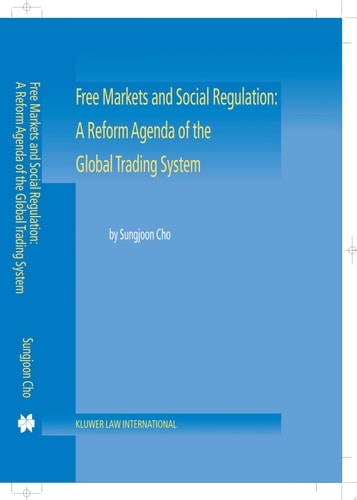
Free Markets and Social Regulation: A Reform Agenda of the Global Trading System Toward a New International Economic Law
0
0
As an Amazon Associate and affiliate partner, Menrva Books earns from qualifying purchases. Learn more
Author Description
Discussion of trade barriers has come round-inevitably it seems-to national regimes of regulatory protection. As the author of this important analysis writes: "Global free trade is hard to imagine under circumstances in which each country seeks to regulate domestic social affairs in its own way, without regard to international norms." Indeed, state regulation has the potential to undermine the very legitimacy of the global trading system. A compelling reconciliation between these two paramount values is essential. Free Markets and Social Regulation: A Reform Agenda of the Global Trading System has a twofold purpose: to consider what has so far been accomplished in this vital mission in the field of international economic law, and to prescribe some solutions to continuing problems. This latter endeavour amounts to a coherent and integrated plan that will enhance the acceptability of free markets to governments, traders, and other stakeholders alike. The challenges analyzed in depth here include the following: the late development in the global trade regime of non-trade policy objectives, which still tend to be treated as mere exceptions to general obligations; the built-in emphasis on products rather than measures; the novel risks associated with the development of modern technology; the case-by-case approach of WTO jurisprudence, which generally fails to investigate whether the substance of any given domestic regulation is necessary to the policy goals of the state in question; and the "technical and economic feasibility" of complying with international trade obligations. The author conducts his analysis in a broad context encompassing the WTO system, the European Union, and the North American Free Trade Agreement. He finds that the clash, despite the particular institutional characteristics of these various organizations, is a major concern of them all. The jus gentium of international trade, he offers, is an imperative combining the
Menrva's Summary
THE THESIS
This book investigates the fundamental tension between global free trade and national regulatory regimes. The author, Sungjoon Cho, addresses the challenge of reconciling these two values by examining the current state of international economic law and proposing solutions. The analysis delves into issues such as the late integration of non-trade policy objectives, the product-centric focus of trade agreements, the implications of modern technology, the limitations of WTO jurisprudence, and the practical feasibility of compliance with international obligations. The work encompasses the WTO system, the European Union, and NAFTA, finding this clash to be a universal concern across these entities.
THE SCOPE MAP
- Analysis of trade barriers and national regulatory protectionism.
- Examination of the legitimacy of the global trading system in the face of diverse domestic regulations.
- Prescription of solutions for a coherent and integrated plan to enhance the acceptability of free markets.
- Discussion of the late development of non-trade policy objectives within the global trade regime.
- Critique of the emphasis on products rather than measures in trade agreements.
- Exploration of novel risks associated with modern technology in international trade.
- Assessment of WTO jurisprudence's case-by-case approach and its failure to investigate regulatory necessity.
- Consideration of the technical and economic feasibility of complying with international trade obligations.
THE AUTHORITY PERSPECTIVE
The book is presented as an important analysis that tackles the critical issue of reconciling global free trade with national social regulation. It aims to provide a reform agenda for the global trading system by examining existing accomplishments and proposing solutions to ongoing problems. The author's work is framed as essential for enhancing the acceptability of free markets to various stakeholders. The analysis is broad, covering major international economic frameworks like the WTO, EU, and NAFTA, indicating a comprehensive approach to a significant contemporary challenge.
Page Count:
217
Publication Date:
2003-01-01
Publisher:
Kluwer Law International B.V.
ISBN-10:
904119892X
ISBN-13:
9789041198921
Politics
Economics
Non-Fiction
Economic Law
Regulation
Global Economy
International Trade
Community Tags
Similar Books





Reader Comments
Share Your Thoughts
No comments yet. Be the first to share your thoughts!