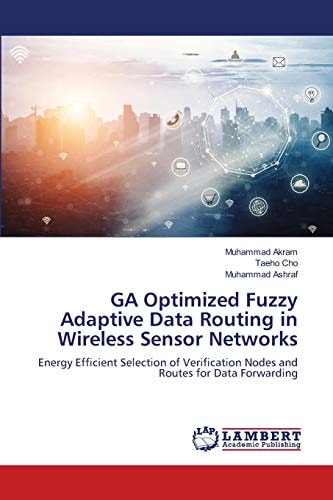
GA Optimized Fuzzy Adaptive Data Routing in Wireless Sensor Networks
0
0
As an Amazon Associate and affiliate partner, Menrva Books earns from qualifying purchases. Learn more
Author Description
Wireless sensor Networks (WSNs) are highly vulnerable to security attacks due to their reliance on wireless communication. Sensor nodes in WSNs are tiny in size and are supplied with limited energy resources and processing capabilities. These energy and hardware-resource-constrained nodes, without suitable safeguards, may be compromised by adversaries. Several en-route filtering schemes have been proposed to filter out false data en-route. However, almost all such schemes presuppose a conventional underlying routing protocol without regard to the attack status and energy dissipation behavior along the path. This book presents fuzzy-based adaptive selection of the intermediate verification nodes and data forwarding paths with dynamic authentication key dissemination to achieve better energy saving. Fuzzy rule-based scheme potentially balances the load between data forwarding paths, chooses the most suitable path for data forwarding, and generates fresh authentication keys and shares with the intermediate verification nodes. Genetic algorithm-based optimization technique automatically optimizes the membership functions in the fuzzy system.
Menrva's Summary
THE THESIS
This book addresses the critical challenge of securing data routing in energy-constrained Wireless Sensor Networks (WSNs) against sophisticated security attacks. It proposes a novel approach utilizing fuzzy logic and genetic algorithms to adaptively select intermediate verification nodes and data forwarding paths, while dynamically disseminating authentication keys. The core innovation lies in balancing the load across forwarding paths, optimizing path selection, and generating fresh authentication keys to enhance energy efficiency and network resilience.
THE SCOPE MAP
- A detailed examination of the vulnerabilities of Wireless Sensor Networks (WSNs) to security attacks.
- Presentation of a fuzzy-based adaptive selection scheme for intermediate verification nodes and data forwarding paths.
- Dynamic authentication key dissemination strategies for enhanced security and energy saving.
- Application of a fuzzy rule-based system to balance load and select optimal data forwarding paths.
- Integration of a Genetic Algorithm-based optimization technique to automatically tune fuzzy system membership functions.
- Methods for generating and sharing fresh authentication keys with intermediate verification nodes.
THE AUTHORITY PERSPECTIVE
The book presents a technical solution to a known problem in Wireless Sensor Networks, focusing on security and energy efficiency. The proposed fuzzy and genetic algorithm-based approach aims to improve data routing by adaptively selecting nodes and paths and managing authentication keys. The methodology suggests a detailed exploration of these techniques for researchers and practitioners in the field. The work is likely to be of interest to those involved in network security, distributed systems, and optimization algorithms.
Page Count:
116
Publication Date:
2018-05-24
Publisher:
LAP Lambert Academic Publishing
ISBN-10:
6139840031
ISBN-13:
9786139840038
Non-Fiction
Science & Technology
Fuzzy Logic
Community Tags
Similar Books