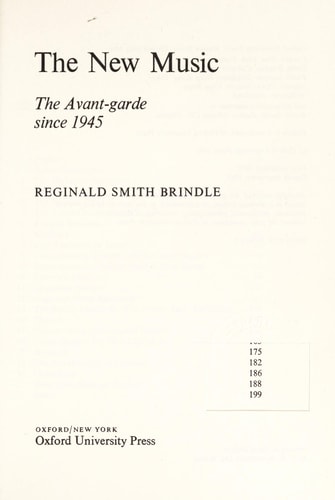
The New Music
0
0
As an Amazon Associate and affiliate partner, Menrva Books earns from qualifying purchases. Learn more
Author Description
This guide to the more adventurous evolutions of music since 1945--pointillism, post-Webernism, integral serialism, free dodecaphony, aleatory and indeterminate music, graphics, musique concrete, electronic music, and theatre music--was first published in 1975 and has been reprinted several times. For this second edition, Smith Brindle has added a new chapter reviewing developments over the decade since first publication. He discusses the decline of experimentalism and the reaction against increasing cerebralism and complexity as variously illustrated by the more recent works of Stockhausen, the minimalist works of Reich and Glass, and the partial return to romanticism. He also reviews the technological revolution which has taken place in computer music and concludes that the future of music will for the time being be most closely associated with technological change and development, rather than with radical changes in compositional techniques.
Menrva's Summary
THE THESIS
This text investigates the evolution of avant-garde musical techniques and compositional philosophies that emerged in the post-1945 era. Reginald Smith Brindle, a composer and academic, utilizes his professional expertise to analyze the shift from rigid serialism toward technological integration. He argues that the trajectory of modern music is increasingly tethered to advancements in computer technology rather than traditional compositional innovation.
THE SCOPE MAP
What You Will Find
- Analysis of pointillism, integral serialism, and free dodecaphony
- Examination of aleatory, musique concrete, and electronic music
- Review of the minimalist movement and the return to romanticism
- Discussion on the impact of computer technology on future musical development
Scope Limits
- Does not provide a comprehensive history of popular or non-Western music
- Focuses primarily on Western art music and experimental composition
THE AUTHORITY PERSPECTIVE
Experts recognize this work as a foundational survey of mid-20th-century experimental music. Readers frequently note the academic density of the prose, which is best suited for students and practitioners of music theory.
Page Count:
206
Publication Date:
1975-01-01
Publisher:
Oxford University Press
ISBN-10:
0193154242
ISBN-13:
9780193154247
Music theory
Music History
20th Century
Musicology
Composition
Community Tags
Similar Books