Laser Light Scattering: Basic Principles and Practice
0
0
As an Amazon Associate and affiliate partner, Menrva Books earns from qualifying purchases. Learn more
Author Description
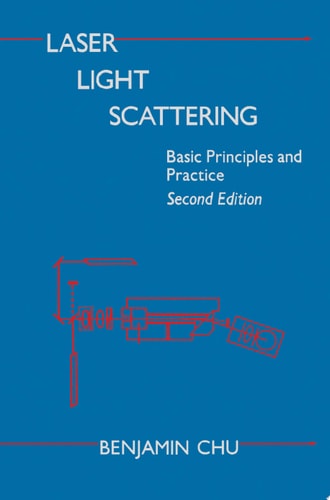
Laser Light Scattering: Basic Principles and Practice, Second Edition deals with the technical aspects of laser light scattering, including the basic principles and practice. Topics covered include light scattering theory, optical mixing spectrometry, photon correlation spectroscopy, and interferometry. Experimental methods and methods of data analysis are also described. This book is comprised of eight chapters and begins with a discussion on the interrelationship between laser light scattering and other types of scattering techniques that use X-rays and neutrons, with particular reference to momentum and energy transfers as well as time-averaged and time-dependent scattered intensity. The spectrum of scattered light and a single-particle approach to time-averaged scattered intensity are considered. The following chapters focus on photoelectric detection of the scattered electric field; optical mixing spectrometers; basic equations for photon correlation spectroscopy; and the principles of Fabry-Perot interferometry. The pertinent features of the experimental aspects of laser light scattering are also outlined, together with the Laplace inversion problem. The final chapter examines polymer molecular-weight distributions in relation to particle sizing. This monograph will be of interest to physicists.
Menrva's Summary
THE THESIS
This book investigates the fundamental principles and practical applications of laser light scattering. It delves into the theoretical underpinnings of light scattering phenomena, exploring techniques such as optical mixing spectrometry, photon correlation spectroscopy, and interferometry. The text also details experimental methodologies and data analysis strategies, providing a comprehensive resource for understanding how laser light interacts with matter to reveal its properties.
THE SCOPE MAP
- Comparison of laser light scattering with X-ray and neutron scattering techniques.
- Analysis of the spectrum of scattered light and single-particle scattering intensity.
- Detailed explanation of photoelectric detection of scattered electric fields.
- Principles and applications of optical mixing spectrometers.
- Mathematical framework for photon correlation spectroscopy.
- Fundamentals of Fabry-Perot interferometry.
- Experimental considerations and the Laplace inversion problem in data analysis.
- Application of laser light scattering to determine polymer molecular-weight distributions and particle sizing.
THE AUTHORITY PERSPECTIVE
This monograph is designed for physicists and researchers interested in the technical aspects of laser light scattering. The comprehensive coverage of theoretical principles, experimental methods, and data analysis techniques suggests a text aimed at providing a thorough understanding of the subject. Its detailed approach to various scattering methodologies indicates its utility as a reference for advanced study and practical application in fields such as materials science and polymer physics.
Page Count:
354
Publication Date:
2012-12-02
Publisher:
Academic Press
ISBN-10:
032316188X
ISBN-13:
9780323161886
Science
Non-Fiction
Spectroscopy
Physics
Optics
Community Tags
Similar Books