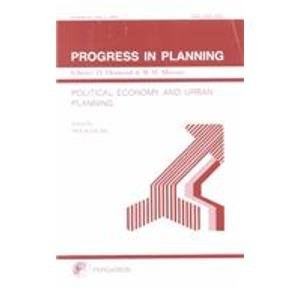
Progress in Planning, Volume 51, Part 1: Political Economy and Urban Planning: A Comparative Study of Hong Kong, Singapore and Taiwan
0
0
As an Amazon Associate and affiliate partner, Menrva Books earns from qualifying purchases. Learn more
Author Description
This study compares urban planning mechanisms that operate within Hong Kong, Singapore and Taiwan. The political economy of Hong Kong is in a state of flux. While the power of the government and the corporate interests remain largely intact, they are challenged by pro-China interests and a democratizing civil society. The land use planning system reflects this power contest. In the face of both strong resistance from the development industry and China's eagerness to perpetuate a market-led society in post-1997 Hong Kong, the outcome of the power contest remains uncertain. The state-centred political economy of Singapore has bred a top-down land use planning system centrally controlled by the government. Not only has the government dominated the plan making process, the legislation has entrusted the public sector to scrutinize and guide private development through a discretionary development control system.
Menrva's Summary
THE THESIS
This book investigates the divergent urban planning mechanisms and political economies of Hong Kong, Singapore, and Taiwan. It examines how the unique political and economic landscapes of each region shape their land use planning systems, highlighting the power dynamics between government, corporate interests, and civil society. The study details Singapore's state-centered, top-down approach, contrasting it with Hong Kong's contested system influenced by pro-China interests and a democratizing civil society. The analysis explores the legislative frameworks and discretionary control systems employed in guiding private development.
THE SCOPE MAP
- Comparative analysis of urban planning in Hong Kong, Singapore, and Taiwan.
- Examination of the political economy of Hong Kong and its impact on land use planning.
- Analysis of the power contest between government, corporate interests, pro-China forces, and civil society in Hong Kong.
- Detailed study of Singapore's state-centered, top-down land use planning system.
- Exploration of the legislative empowerment of the public sector in Singapore's development control.
- Discussion of the discretionary development control system in Singapore.
- Assessment of the uncertain outcomes of power contests in Hong Kong's planning system.
THE AUTHORITY PERSPECTIVE
This volume, as part of the Progress in Planning series, offers a detailed comparative analysis of urban planning systems in East Asian contexts. The study's strength lies in its examination of the intricate interplay between political economy and planning practices in Hong Kong, Singapore, and Taiwan. It provides a nuanced perspective on how governmental structures, economic forces, and societal pressures shape urban development strategies. The work is likely to be of significant interest to academics and practitioners in urban planning, political science, and regional studies.
Page Count:
90
Publication Date:
1999-06-30
Publisher:
Elsevier Science
ISBN-10:
0080435807
ISBN-13:
9780080435800
Politics
Non-Fiction
Economics
urban planning
Hong Kong
Singapore
Taiwan
Community Tags
Similar Books