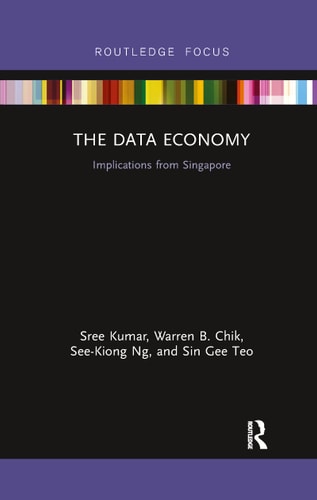
The Data Economy: Implications from Singapore
0
0
As an Amazon Associate and affiliate partner, Menrva Books earns from qualifying purchases. Learn more
Author Description
The data economy" is a term used by many, but properly understood by few. Even more so the concept of "big data". Both terms embody the notion of a digital world in which many transactions and data flows animate a virtual space. This is the unseen world in which technology has become the master, with the hand of the human less visible. In fact, however, it is human interaction in and around technology that makes data so pervasive and important - the ability of the human mind to extract, manipulate and shape data that gives meaning to it. This book outlines the findings and conclusions of a multidisciplinary team of data scientists, lawyers, and economists tasked with studying both the possibilities of exploiting the rich data sets made available from many human-technology interactions and the practical and legal limitations of trying to do so. It revolves around a core case study of Singapore's public transport system, using data from both the private company operating the contactless payment system (EZ-Link) and the government agency responsible for public transport infrastructure (Land Transport Authority). In analysing both the possibilities and the limitations of these data sets, the authors propose policy recommendations in terms of both the uses of large data sets and the legislation necessary to enable these uses while protecting the privacy of users.
Menrva's Summary
THE THESIS
The book investigates the multifaceted implications of the data economy, particularly concerning the exploitation of large datasets and the legal frameworks governing their use. It examines how human interaction with technology generates pervasive data, and how the human mind's ability to extract and shape this data imbues it with meaning. A multidisciplinary team of data scientists, lawyers, and economists studied the possibilities and limitations of utilizing rich datasets, with a central case study on Singapore's public transport system, drawing data from EZ-Link and the Land Transport Authority. The authors propose policy recommendations for the use of big data and the necessary legislation to enable these uses while safeguarding user privacy.
THE SCOPE MAP
- Analysis of the 'data economy' and 'big data' concepts.
- Exploration of human-technology interactions and their role in data generation.
- Case study: Singapore's public transport system (EZ-Link and Land Transport Authority data).
- Examination of practical and legal limitations in data exploitation.
- Findings and conclusions from a multidisciplinary team (data scientists, lawyers, economists).
- Policy recommendations for big data utilization.
- Legislative proposals for enabling data use while protecting user privacy.
THE AUTHORITY PERSPECTIVE
This book is positioned as an in-depth analysis of the data economy, drawing on a multidisciplinary approach to explore both the potential and the constraints of big data. The focus on a specific, real-world case study in Singapore suggests a practical and grounded examination of policy and legal considerations. The authors' aim to propose actionable recommendations indicates a target audience interested in the governance and ethical implications of data science.
Page Count:
116
Publication Date:
2020-06-30
Publisher:
Taylor & Francis Group
ISBN-10:
0367606712
ISBN-13:
9780367606718
Science & Technology
Non-Fiction
Economics
Data Science
Public Policy
Technology
Law
Singapore
Community Tags
Similar Books