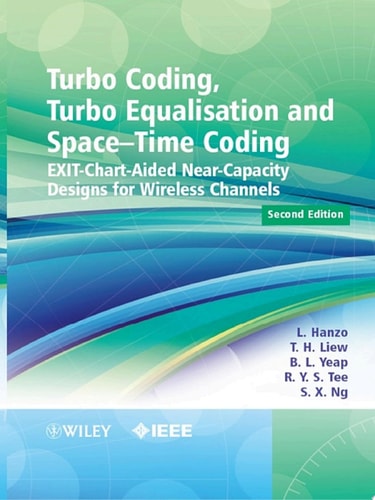
Turbo Coding, Turbo Equalisation and Space-Time Coding: EXIT-Chart-Aided Near-Capacity Designs for Wireless Channels
0
0
As an Amazon Associate and affiliate partner, Menrva Books earns from qualifying purchases. Learn more
Author Description
Covering the full range of channel codes from the most conventional through to the most advanced, the second edition of Turbo Coding, Turbo Equalisation and Space-Time Coding is a self-contained reference on channel coding for wireless channels. The book commences with a historical perspective on the topic, which leads to two basic component codes, convolutional and block codes. It then moves on to turbo codes which exploit iterative decoding by using algorithms, such as the Maximum-A-Posteriori (MAP), Log-MAP and Soft Output Viterbi Algorithm (SOVA), comparing their performance. It also compares Trellis Coded Modulation (TCM), Turbo Trellis Coded Modulation (TTCM), Bit-Interleaved Coded Modulation (BICM) and Iterative BICM (BICM-ID) under various channel conditions. The horizon of the content is then extended to incorporate topics which have found their way into diverse standard systems. These include space-time block and trellis codes, as well as other Multiple-Input Multiple-Output (MIMO) schemes and near-instantaneously Adaptive Quadrature Amplitude Modulation (AQAM). The book also elaborates on turbo equalisation by providing a detailed portrayal of recent advances in partial response modulation schemes using diverse channel codes. A radically new aspect for this second edition is the discussion of multi-level coding and sphere-packing schemes, Extrinsic Information Transfer (EXIT) charts, as well as an introduction to the family of Generalized Low Density Parity Check codes. This new edition includes recent advances in near-capacity turbo-transceivers as well as new sections on multi-level coding schemes and of Generalized Low Density Parity Check codes Comparatively studies diverse channel coded and turbo detected systems to give all-inclusive information for researchers, engineers and students Details EXIT-chart based irregular transceiver designs Uses rich performance comparisons as well
Menrva's Summary
THE THESIS
This book investigates the design of near-capacity transceivers for wireless channels by leveraging Extrinsic Information Transfer (EXIT) charts and advanced coding techniques. The authors, with expertise in wireless communications, present a comprehensive reference that begins with a historical overview and foundational codes like convolutional and block codes. It progresses to explore turbo codes, iterative decoding algorithms (MAP, Log-MAP, SOVA), and compares various coded modulation schemes (TCM, TTCM, BICM, BICM-ID) under different channel conditions. The text extends to Multiple-Input Multiple-Output (MIMO) schemes, space-time codes, and turbo equalization, with a significant focus on multi-level coding, sphere-packing, and Generalized Low Density Parity Check (GLDPC) codes.
THE SCOPE MAP
- Historical perspective on channel coding for wireless communications.
- Detailed explanation of convolutional and block codes.
- In-depth analysis of turbo codes and iterative decoding algorithms (MAP, Log-MAP, SOVA).
- Comparative studies of Trellis Coded Modulation (TCM), Turbo Trellis Coded Modulation (TTCM), Bit-Interleaved Coded Modulation (BICM), and Iterative BICM (BICM-ID).
- Coverage of space-time block and trellis codes, and other MIMO schemes.
- Elaboration on turbo equalization techniques, including partial response modulation.
- Discussion of multi-level coding, sphere-packing schemes, and Extrinsic Information Transfer (EXIT) charts.
- Introduction to Generalized Low Density Parity Check (GLDPC) codes and near-capacity turbo-transceiver designs.
THE AUTHORITY PERSPECTIVE
The second edition of Turbo Coding, Turbo Equalisation and Space-Time Coding is presented as a self-contained reference for researchers, engineers, and students in the field of wireless channel coding. It offers comprehensive information through comparative studies of diverse channel coded and turbo detected systems. The inclusion of EXIT-chart based irregular transceiver designs and recent advances in near-capacity turbo-transceivers, along with new sections on multi-level coding and GLDPC codes, highlights its updated and extensive scope. The book aims to provide all-inclusive information for its target audience.
Page Count:
676
Publication Date:
2011-05-03
Publisher:
Wiley
ISBN-10:
0470978333
ISBN-13:
9780470978337
Science & Technology
Non-Fiction
Science
Engineering
Telecommunications
Electrical Engineering
Community Tags
Similar Books








Reader Comments
Share Your Thoughts
No comments yet. Be the first to share your thoughts!