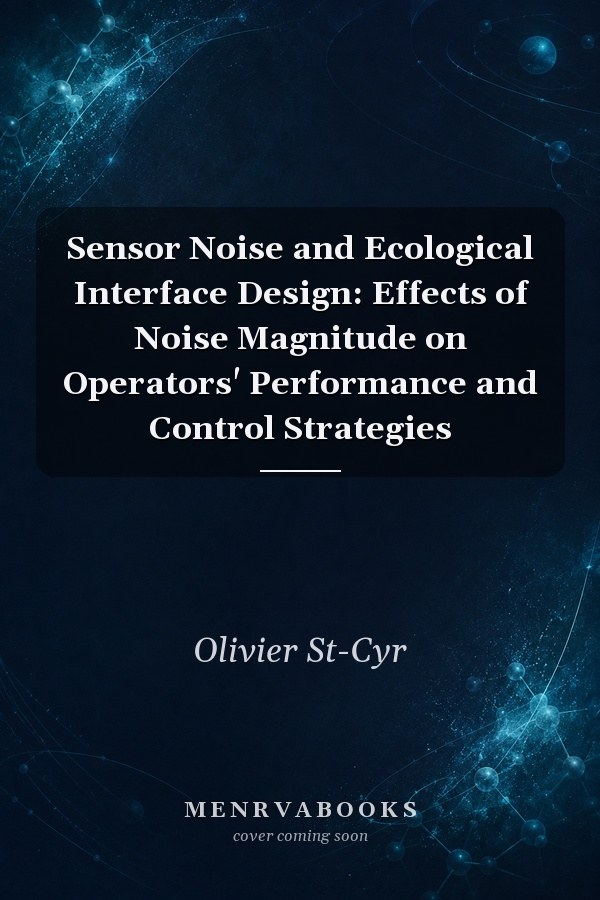
Sensor Noise and Ecological Interface Design: Effects of Noise Magnitude on Operators' Performance and Control Strategies
0
0
As an Amazon Associate and affiliate partner, Menrva Books earns from qualifying purchases. Learn more
Author Description
The purpose of this dissertation was to investigate the effects of the presence and magnitude of sensor noise on operators' performance and control strategies using an Ecological Interface Design (EID) interface and a Single-Sensor Single-Indicate (SSSI) interface. To assist in the study of this topic, concepts from sensor technology, cognitive psychology, and cognitive engineering were utilized. Three studies were conducted using different types of sensor noise perturbations with DURESS III, a representative thermal-hydraulic process simulation: (1) global random increases in sensor noise magnitude, (2) global gradual increases in sensor noise magnitude, and (3) local gradual increases in sensor noise magnitude. Three displays (P, P+S, and P+F) were used in the studies, motivated by different interface design principles. There were four main findings. First, the EID condition performed significantly better than the SSSI conditions when sensor noise was set to an industry average level. Second, the robustness of the EID interface was compromised by global and large increases in sensor noise magnitude, but no more than the SSSI interface. Third, increasing the magnitude of sensor noise in selected low-level sensors had an impact on the performance and control stability of the EID condition, but no more than the SSSI condition. Fourth, in all three studies, the introduction of uncertainty in the form of sensor noise to both EID and SSSI interfaces forced participants to explore different control strategies. A number of contributions resulted from this research. First, this was the first set of studies to use the DURESS III microworld to investigate the impact of sensor noise on performance and control strategies. Second, this is the first piece of research to empirically assess the impact of different sensor noise magnitudes on the robustness of an EID interface. Third, this dissertation was the first to empirically investigate issues related to increases in sensor no
Menrva's Summary
THE THESIS
This dissertation investigates how the presence and magnitude of sensor noise affect operator performance and control strategies within different interface designs. The research utilizes concepts from sensor technology, cognitive psychology, and cognitive engineering to analyze these effects. Three studies were conducted using the DURESS III simulation, employing varying types and magnitudes of sensor noise perturbations across different display designs (P, P+S, and P+F). The findings address the performance differences between Ecological Interface Design (EID) and Single-Sensor Single-Indicate (SSSI) interfaces under various noise conditions, and explore the adaptive control strategies operators develop in response to introduced uncertainty.
THE SCOPE MAP
- Analysis of sensor noise effects on operator performance and control strategies.
- Comparison of Ecological Interface Design (EID) and Single-Sensor Single-Indicate (SSSI) interfaces.
- Three experimental studies using the DURESS III thermal-hydraulic process simulation.
- Investigation of global and local increases in sensor noise magnitude.
- Examination of different display designs (P, P+S, P+F) motivated by interface design principles.
- Empirical assessment of sensor noise magnitudes on EID interface robustness.
- Exploration of operator adaptation to uncertainty through varied control strategies.
THE AUTHORITY PERSPECTIVE
This dissertation presents empirical findings on the impact of sensor noise on operator performance within distinct interface designs. The research contributes to the fields of human factors and cognitive engineering by providing the first studies to use the DURESS III microworld for this specific investigation and the first to empirically assess the impact of different sensor noise magnitudes on the robustness of an EID interface. The work also empirically investigates issues related to increases in sensor noise, offering insights into how operators adapt their control strategies when faced with uncertainty.
Page Count:
516
Publication Date:
2006-01-01
Publisher:
University of Toronto
ISBN-10:
0494158646
ISBN-13:
9780494158647
Non-Fiction
Science
Industrial Processes
Research
Cognitive Engineering
Human Factors
Community Tags
Similar Books









Reader Comments
Share Your Thoughts
No comments yet. Be the first to share your thoughts!