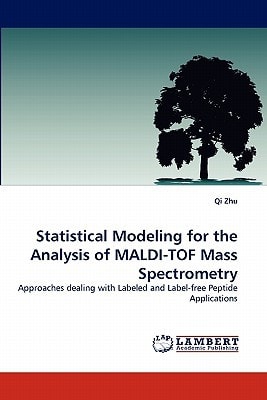
Statistical Modeling for the Analysis of MALDI-TOF Mass Spectrometry
0
0
As an Amazon Associate and affiliate partner, Menrva Books earns from qualifying purchases. Learn more
Author Description
The analsyses involve novel as well as application oritented statistical methodologies applied to the mass spectrometry based proteomics data. This is a new research area in the statistical point of view, and it requires non-routine statistical modeling approaches. The analyses are based on the assumption of unknown peptide sequences. In such situation, more elaborate statistical modeling approaches need to be developed, to account for the uncertainty caused by the estimation of the masses of the peptides. Two topics are considered in the analyses. The first topic is to separate and quantify overlapping peptides for the label-free applications. The challenge to this topic is to distinguish the isotopic peaks from different peptides which cause an overlap in a spectrum. The second topic aims towards one of the recently developed labeling techniques-- the enzymatic 18O labeling. The key difficulty lies in this topic is how to account for incomplete labeling, non-constant residual variance, etc. Both frequentist and Bayesian approaches are applied. Bayesian analysis becomes the unique choice when non-identifiability issues arise without the incorporation of prior information.
Menrva's Summary
THE THESIS
This book investigates novel statistical methodologies for analyzing MALDI-TOF mass spectrometry data, particularly in the context of proteomics. The author addresses the challenges of unknown peptide sequences, requiring elaborate statistical modeling to manage the uncertainty in peptide mass estimation. Two primary topics are explored: separating and quantifying overlapping peptides in label-free applications, and accounting for complexities in enzymatic 18O labeling, such as incomplete labeling and non-constant residual variance. Both frequentist and Bayesian approaches are employed, with Bayesian analysis being essential for non-identifiability issues when prior information is incorporated.
THE SCOPE MAP
- Application of novel statistical methodologies to mass spectrometry-based proteomics data.
- Development of non-routine statistical modeling approaches for a new research area.
- Statistical modeling to account for uncertainty from estimated peptide masses when sequences are unknown.
- Methods for separating and quantifying overlapping peptides in label-free mass spectrometry.
- Distinguishing isotopic peaks from different peptides that cause spectral overlap.
- Statistical approaches for enzymatic 18O labeling, addressing incomplete labeling and non-constant residual variance.
- Application of both frequentist and Bayesian statistical methods.
- Use of Bayesian analysis to resolve non-identifiability issues through prior information.
THE AUTHORITY PERSPECTIVE
The book presents advanced statistical techniques for a specialized area of scientific research, focusing on the complex challenges within MALDI-TOF mass spectrometry and proteomics. The detailed exploration of methodologies for label-free quantification and enzymatic labeling suggests a text aimed at researchers and statisticians working in bioinformatics and analytical chemistry. The application of both frequentist and Bayesian approaches indicates a comprehensive treatment of statistical modeling relevant to current scientific inquiry.
Page Count:
360
Publication Date:
2011-01-01
Publisher:
Lap Lambert Academic Publishing GmbH KG
ISBN-10:
3843394466
ISBN-13:
9783843394468
Non-Fiction
Science
Proteomics
Data Analysis
Biostatistics
Community Tags
Similar Books