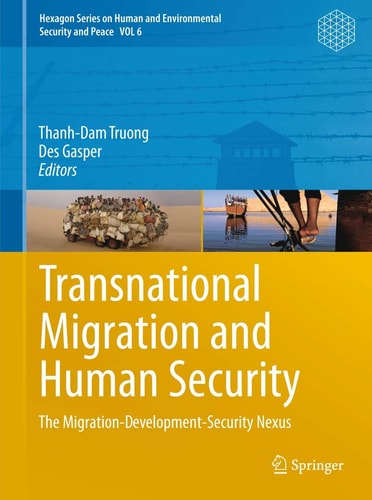
Transnational Migration and Human Security: The Migration-Development-Security Nexus
0
0
As an Amazon Associate and affiliate partner, Menrva Books earns from qualifying purchases. Learn more
Author Description
The volume places the migration-development-security nexus in the field of transnational studies. Rather than treating these three categories as self-evident, the essays excavate aspects of power and privilege built into their governing frameworks and conflicting rationales apparent in practices of control. Bringing together diverse experiences and case studies, the volume highlights the problematic nature of maintaining distinct and disconnected frameworks of governance. It argues for a new approach that demonstrates the significance and usefulness of comparative ethics in conceptualising migration from a human-centered and gendered perspective in order to address the multi-facetted and multi-dimensional nature and meanings of "security".
Menrva's Summary
THE THESIS
This volume interrogates the complex interplay between migration, development, and security, challenging conventional understandings of these interconnected fields. The essays within this collection critically examine the power dynamics and privileges embedded in existing governance frameworks for migration, development, and security. By analyzing conflicting rationales and practices of control through diverse experiences and case studies, the book reveals the limitations of maintaining separate, disconnected governance models. It advocates for a novel approach that leverages comparative ethics to conceptualize migration from a human-centered and gendered perspective, thereby addressing the multifaceted nature of security.
THE SCOPE MAP
- Analysis of the migration-development-security nexus within transnational studies.
- Excavation of power and privilege within governing frameworks of migration, development, and security.
- Examination of conflicting rationales and practices of control in migration management.
- Integration of diverse experiences and case studies to highlight governance challenges.
- Argument for a new approach utilizing comparative ethics.
- Conceptualization of migration from a human-centered perspective.
- Inclusion of a gendered perspective in migration analysis.
- Addressing the multi-faceted and multi-dimensional nature of 'security'.
THE AUTHORITY PERSPECTIVE
The collection is positioned as a critical intervention in transnational studies, aiming to reframe the discourse around migration, development, and security. It seeks to move beyond established, often siloed, approaches by emphasizing the interconnectedness of these domains and the inherent power structures within their governance. The volume's focus on comparative ethics and a human-centered, gendered perspective suggests an academic audience interested in interdisciplinary approaches to global challenges. Its contribution lies in challenging conventional frameworks and advocating for a more integrated and nuanced understanding of security in the context of transnational migration.
Page Count:
370
Publication Date:
2013-08-03
Publisher:
Springer Berlin Heidelberg
ISBN-10:
3642268617
ISBN-13:
9783642268618
Economics
Non-Fiction
Politics
Transnational Studies
Gender Studies
Human security
Migration Studies
Community Tags
Similar Books