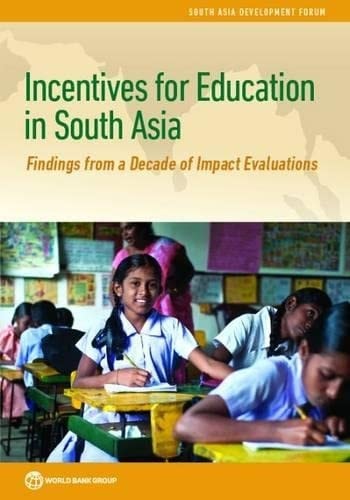
Incentives for Education in South Asia: Findings from a Decade of Impact Evaluations
0
0
As an Amazon Associate and affiliate partner, Menrva Books earns from qualifying purchases. Learn more
Author Description
The past decade has seen a dramatic increase in access to schooling across the South Asia region, with the coverage of primary education becoming almost universal and that of secondary education increasing steadily. But the quality of education remains a concern and the key challenge policy makers face today is making progress towards improving learning outcomes. The traditional way to address this challenge was to mobilize more budget resources, train teachers, improve curricula and distribute textbooks, among others. But input-based approaches have been questioned in recent years. Resources alone may not hold the answer if they are not put to good use. Frequent absenteeism by teachers suggests that their incentives are not aligned with those of policy makers. School principals lack the necessary autonomy to run their schools. Families may not fully grasp the importance education has for their children's future, or may lack the resources to send them to private schools. And communities may not be empowered to demand that local schools deliver as promised.Over the last decade, new approaches inspired by agency theories and behavioral sciences have built on these insights to experiment on the ground. The incentives faced by teachers, principals, families and communities have been tilted using bonuses, discretionary budget allocations, cash transfers, vouchers and local election rules, and the consequences have been assessed. Evaluations have focused on a range of outcomes, including daily attendance, education costs, school choice and learning outcomes. Nowhere has this drive towards rigorous impact evaluation been stronger than in South Asia. By now, dozens of experiments involving well-defined treatment and control groups allow to pause and take stock. This study summarizes the rich evidence accumulated by the region over the last decade, conducting a rigorous meta-analysis to identify possible design and publication biases, and relating the findings to the broader
Menrva's Summary
THE THESIS
This book investigates the effectiveness of various incentive-based approaches to improving educational quality and learning outcomes in South Asia over the past decade. The authors, drawing on a decade of rigorous impact evaluations, address the challenge of improving learning outcomes beyond traditional input-based methods. They examine how incentives for teachers, principals, families, and communities have been adjusted through mechanisms like bonuses, discretionary budgets, cash transfers, and vouchers, and assess the consequences on attendance, costs, school choice, and learning. The study synthesizes evidence from numerous experiments in South Asia, employing meta-analysis to identify design and publication biases and relate findings to broader policy implications.
THE SCOPE MAP
- A comprehensive review of impact evaluations on education in South Asia from the last decade.
- Analysis of incentive-based interventions for teachers, principals, families, and communities.
- Examination of outcomes including daily attendance, education costs, school choice, and learning achievements.
- A meta-analysis to identify design and publication biases in the evaluated studies.
- Discussion of policy implications and the alignment of incentives with educational goals.
THE AUTHORITY PERSPECTIVE
This study synthesizes a decade of rigorous impact evaluations on education in South Asia, a region that has seen significant increases in school access but faces persistent challenges in educational quality and learning outcomes. The book's approach, which moves beyond traditional input-based strategies to explore the impact of tailored incentives for various stakeholders, is grounded in agency theories and behavioral sciences. By conducting a meta-analysis, the authors aim to provide a robust understanding of what works, identifying potential biases and offering evidence-based recommendations for policymakers. The work is positioned as a critical stock-taking of the extensive experimental evidence generated in the region.
Page Count:
184
Publication Date:
2014-12-01
Publisher:
World Bank Publications
ISBN-10:
146480365X
ISBN-13:
9781464803659
Non-Fiction
Politics
Economics
South Asia
Policy
Education
Community Tags
Similar Books










Reader Comments
Share Your Thoughts
No comments yet. Be the first to share your thoughts!