Economics of Regional Transport Infrastructure in Asia
0
0
As an Amazon Associate and affiliate partner, Menrva Books earns from qualifying purchases. Learn more
Author Description
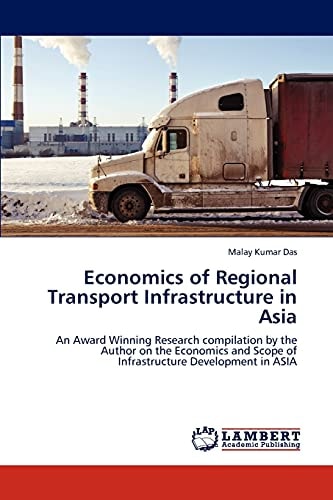
Infrastructure capital can be considered a necessary condition to extend the regional production potential but not automatically a sufficient requirement for enhanced regional competitiveness and income. The materialization of a region's higher production potential rather relies on the region's ability to utilize the existing and additional infrastructure capital in an efficient way. Against this background, the paper intends to identify Asian regions' environment with public transport infrastructure and their efficiency in using it. Therefore, the role of transport infrastructure is contrasted with the importance of other region-specific production factors namely educational attainments of the workforce and the availability of modern telecommunication networks. In order to increase the comparability of the regions, the latter are clustered according the land use pattern and industrial structure in a first step. In a second step a quantile regression analysis is performed for each cluster and factor. This, in turn, allows for a sequential bottleneck analysis. This paper explores quantifying the welfare effects of developing regional infrastructure in Asia.
Menrva's Summary
THE THESIS
This paper investigates the complex relationship between regional transport infrastructure and economic development in Asia, questioning whether infrastructure alone guarantees increased competitiveness. The author, Malay Kumar Das, examines how efficiently regions utilize existing and new transport infrastructure, contrasting its role with other crucial production factors like workforce education and telecommunication networks. To facilitate comparison, Asian regions are first clustered based on land use and industrial structure. Subsequently, a quantile regression analysis is applied to each cluster and factor to identify sequential bottlenecks and quantify the welfare effects of regional infrastructure development.
THE SCOPE MAP
- Analysis of the role of infrastructure capital in extending regional production potential.
- Assessment of the efficiency of Asian regions in utilizing public transport infrastructure.
- Contrast between transport infrastructure and other production factors: educational attainment and telecommunication networks.
- Clustering of Asian regions based on land use patterns and industrial structure.
- Quantile regression analysis performed for each cluster and factor.
- Sequential bottleneck analysis to identify limitations in infrastructure utilization.
- Quantification of welfare effects stemming from regional infrastructure development in Asia.
THE AUTHORITY PERSPECTIVE
The book's approach, focusing on the efficient utilization of infrastructure rather than its mere existence, suggests a nuanced perspective on regional development economics. The methodology, involving regional clustering and quantile regression, indicates a data-driven and analytical treatment of the subject matter. This framework allows for a detailed examination of specific bottlenecks and the quantifiable impact of infrastructure investments. The study is positioned to offer insights into optimizing development strategies within the diverse Asian economic landscape.
Page Count:
120
Publication Date:
2011-12-01
Publisher:
Lap Lambert Academic Publishing GmbH KG
ISBN-10:
3847302256
ISBN-13:
9783847302254
Economics
Non-Fiction
Infrastructure
Transportation
Community Tags
Similar Books