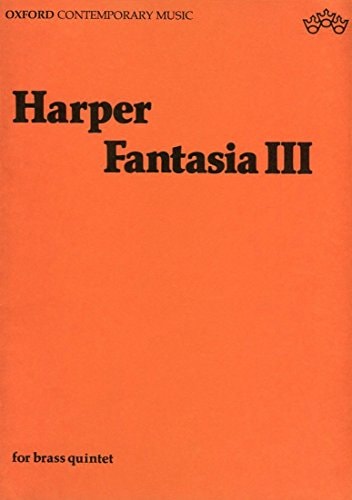
Fantasia III, for Brass Quintet
0
0
As an Amazon Associate and affiliate partner, Menrva Books earns from qualifying purchases. Learn more
Author Description
Fantasia III was commissioned by the Albany Brass Consort, with funds made available by the Scottish Arts Council, and first performed on 3 November 1977 at St Cecilia’s Hall, Edinburgh. The piece is based on the first of William Byrd’s elegies for Sir Philip Sidney, ‘Come to me, grief, for ever’, published in the ‘Psalmes, Sonnets and Songs’ of 1588. Edward Harper (1941-2009) read music at Oxford and studied composition with Gordon Jacob at the RCM and later in Milan with Donatoni. His music combines emotional directness with a close-textured refinement and his treatment of the music of older composers -- also including Byrd, Schubert, and Elgar -- is eager and generous, sometimes humorous, but never swerving into irony. After the culmination of his early serial style in the Piano Concerto (1970), a return to tonality and an interest in the reworking of older music was marked by Bartók Games (1972). These features persisted in the one-act opera Fanny Robin (1975) which utilises a theme from Purcell's Dido & Aeneas (with which it is intended to be performed), as well as echoing the melos of English folksong. The widely-performed Intrada after Monteverdi, written for the 1982 Edinburgh Festival, develops material from the opening toccata of Orfeo. The opera Hedda Gabler, performed by Scottish Opera in 1985, on a libretto after Ibsen, is Harper's most ambitious work, and reveals an eloquent dramatic voice. Like Fanny Robin and the chamber opera The Mellstock Quire (1988), it contains passages of spoken melodrama. The quintessentially English quality in many of Harper's works is especially evident in the Homage to Thomas Hardy (1990). His music combines emotional directness with a close-textured refinement. His treatment of the music of older composers, who also include Byrd, Schubert, Elgar, and Dallapiccola, is eager and generous, sometimes humorous, but never swerving into irony.
Menrva's Summary
THE THESIS
This work investigates the structural and thematic integration of Renaissance vocal music into a contemporary brass quintet framework. Edward Harper, a composer with a background in serialism and a later focus on tonal reinterpretation, utilizes the 16th-century elegy of William Byrd as the foundational material for this composition. The piece serves as a case study in how historical source material can be adapted for modern instrumentation while maintaining the emotional integrity of the original work.
THE SCOPE MAP
What You Will Find
- A musical arrangement for a standard brass quintet ensemble.
- A compositional analysis of William Byrd’s 1588 elegy 'Come to me, grief, for ever'.
- Historical context regarding the commission by the Albany Brass Consort.
- Technical insights into Harper's methodology of reworking older music without resorting to irony.
THE AUTHORITY PERSPECTIVE
Experts recognize this work as a significant example of Harper's mid-career shift toward tonal reinterpretation and historical homage. Musicians frequently note the technical demands placed on the brass ensemble to capture the refined, close-textured quality characteristic of the composer's style.
Page Count:
35
Publication Date:
1987-01-01
Publisher:
Oxford University Press
ISBN-10:
0193568845
ISBN-13:
9780193568846
Music
Chamber Music
Sheet Music
Community Tags
Similar Books