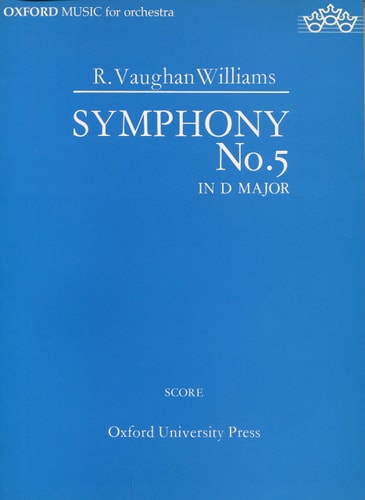
Symphony No. 5 in D Major: Full Score
0
0
As an Amazon Associate and affiliate partner, Menrva Books earns from qualifying purchases. Learn more
Author Description
The Symphony in D major was written between 1938 and 1943. In style it represents a shift away from the violent dissonance of the Fourth Symphony and a return to the more romantic style of the earlier Pastoral Symphony. It is also noteworthy as perhaps the quietest symphony Vaughan Williams ever wrote, with only a very few passages rising even to a forte. The texture throughout the work is strongly dominated by the strings. Many of the musical themes in the Fifth Symphony stem from Vaughan Williams's then-unfinished opera, The Pilgrim's Progress. This opera, or "morality" as the composer preferred to call it, had been in gestation for decades, and the composer had temporarily abandoned it at the time the symphony was conceived. Despite its origins, the symphony is without programmatic context, and is in the form of an extended development of musical themes taken from the morality rather than an attempt to cast it directly into symphonic form. When Vaughan Williams started writing the symphony in 1938, he had been working on The Pilgrim's Progress for thirty years. By the 1940s he had appeared to have abandoned the work, and decided to incorporate some of its ideas and themes into other works, most notably the Fifth Symphony. In January 1943, Vaughan Williams arranged for two of his friends to play through the newly completed piano duet score of the symphony. In later years his widow, Ursula, recalled that he was not impressed after hearing it, causing him to doubt his new work. After hearing the first orchestral rehearsal by the London Philharmonic he changed his mind. The Fifth Symphony was premiered on 24 June 1943 at a Proms Concert in the Royal Albert Hall in London by the London Philharmonic Orchestra conducted by the composer. The American première was given in Carnegie Hall on 30 November 1944 by the Philharmonic-Symphony Society of New York led by Music Director Artur Rodziński.
Menrva's Summary
THE THESIS
This volume provides the complete orchestral score for Ralph Vaughan Williams's Symphony No. 5 in D Major, an investigation into the composer's transition from dissonant modernism to a more contemplative, romantic harmonic language. The work serves as a primary source document for conductors, musicologists, and performers, detailing the structural integration of themes originally intended for the composer's long-gestating opera, The Pilgrim's Progress. By presenting the full score, the text allows for a granular analysis of the symphony's unique string-dominated texture and its restrained dynamic range.
THE SCOPE MAP
What You Will Find
- Full orchestral instrumentation and notation for all four movements of the symphony
- Historical context regarding the composition period between 1938 and 1943
- Analysis of thematic material derived from the composer's unfinished morality opera
- Technical documentation of the work's premiere and subsequent performance history
THE AUTHORITY PERSPECTIVE
Musicologists and conductors frequently cite this score as a foundational text for understanding the mid-century shift in British symphonic writing. Readers often note the clarity of the notation and the importance of the score in identifying the subtle thematic links between the symphony and the composer's operatic output.
Page Count:
118
Publication Date:
1969-01-01
Publisher:
Oxford University Press
ISBN-10:
0193694158
ISBN-13:
9780193694156
Music
Scores
Symphony
Music theory
Songbooks
Community Tags
Similar Books