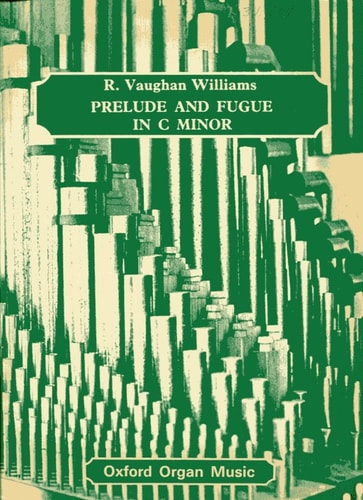
Prelude and Fugue in C Minor
0
0
As an Amazon Associate and affiliate partner, Menrva Books earns from qualifying purchases. Learn more
Author Description
Vaughan Williams's Prelude and Fugue in C minor (1921) is characterized by a sense of drama and punctuated by bristling dissonances. The Prelude's ritornello-like alternation of chordal grandeur and rapid imitative sections recalls Bach's great organ Prelude and Fugue in the same key, while the rhythmically complicated Fugue, whose subject looks ahead to the composer's Sixth Symphony, displays great ingenuity in its counterpoint, fully justifying the assertiveness of its final peroration in C major.
Menrva's Summary
THE THESIS
This work investigates the structural and harmonic evolution of the organ Prelude and Fugue form as interpreted by Ralph Vaughan Williams in his 1921 composition. The author, a prominent 20th-century composer, utilizes this specific piece to bridge the gap between Baroque traditions and modern symphonic complexity. By analyzing the interplay between chordal grandeur and contrapuntal ingenuity, the text provides a framework for understanding the transition from classical organ structures to the composer's later symphonic language.
THE SCOPE MAP
What You Will Find
- Detailed musical notation for the Prelude and Fugue in C minor
- Analysis of ritornello-like structural patterns
- Examination of contrapuntal techniques and rhythmic complexity
- Historical context linking the piece to the composer's Sixth Symphony
THE AUTHORITY PERSPECTIVE
Musicologists and organists frequently cite this edition as a critical resource for studying Vaughan Williams's approach to keyboard counterpoint. Experts highlight the text as a foundational score for performers interested in the intersection of 20th-century dissonance and traditional organ forms.
Page Count:
16
Publication Date:
1930-01-01
Publisher:
Oxford University Press Music
ISBN-10:
0193759446
ISBN-13:
9780193759442
Music
Sheet Music
Organ Music
Instruments
Musical Genres
Self Service
Songbooks
Scores
Community Tags
Similar Books