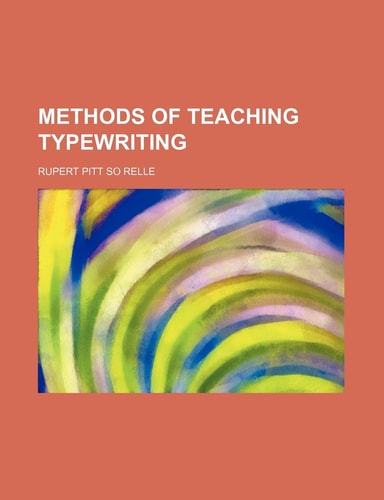
Methods of Teaching Typewriting
0
0
As an Amazon Associate and affiliate partner, Menrva Books earns from qualifying purchases. Learn more
Author Description
This historic book may have numerous typos and missing text. Purchasers can download a free scanned copy of the original book (without typos) from the publisher. Not indexed. Not illustrated. 1919 Excerpt:... get speed. Some time ago a typist complained to me that he couldn't get speed, no matter how hard he tried. I asked him to write for me. He consented. I gave him fifteen minutes' copying to do, and promptly went about my business. He thought I was going to "time" him to see how rapidly he could write; what I wanted was to see him write without his being actually conscious of it. In a few minutes he settled down to business, and I then surreptitiously kept my weather eye open for his troubles. Here are some of the things he did: In returning the carriage he used both hands, thus making it necessary to return both to the keyboard every time. At the end of a sentence he would depress the shift-key, strike the period, release the shift-key, strike the space bar twice, then depress the shift-key again and strike the capital. In shifting he drew his whole hand down to the lower bank of keys, instead of merely dropping the little finger to the shift-key and maintaining correct hand position. To indent for paragraphs he would return the carriage and space five times with the thumb, instead of using the Self-starter or tabulator key. He had so little independent finger control that practically all the fingers did the work on each stroke. That is, when he would strike "b," for example, the second, third and fourth fingers of that hand would fly up into the air, and naturally had to be brought down again. He also raised his fingers about twice as high above the keys as was actually necessary. He kept continually glancing at the machine instead of keeping his eyes glued on the copy. He kept changing his position in the chair. On coming to any infrequent character he had to shift his gaze to the machine to find the character. In making the reach fro...
Menrva's Summary
THE THESIS
This book addresses the fundamental challenges and techniques in teaching typewriting during the early 20th century. The author, Rupert P. So Relle, details common errors made by typists, such as inefficient carriage returns, improper shifting, and lack of independent finger control, illustrating these with a specific case study of a typist struggling with speed. The text aims to guide instructors in identifying and correcting these faults to improve student proficiency and efficiency on the typewriter.
THE SCOPE MAP
- Analysis of common typist errors impacting speed and accuracy.
- Detailed examples of incorrect techniques in carriage return, shifting, and paragraph indentation.
- Emphasis on developing independent finger control and proper hand positioning.
- Guidance on maintaining focus on copy rather than the machine.
- Strategies for improving typing speed through correct practice methods.
- Discussion of the importance of consistent posture and machine familiarity.
- Identification of inefficient practices like excessive key reach and unnecessary finger elevation.
THE AUTHORITY PERSPECTIVE
This historical text offers a direct look into the pedagogical methods of early 20th-century typewriting instruction. The excerpt highlights a practical, observational approach to identifying and correcting student errors, suggesting a focus on mechanical efficiency and habit formation. The publisher's note indicates that the original text may contain imperfections, with a scanned copy available, implying a focus on historical preservation and accessibility for researchers or enthusiasts of the subject.
Page Count:
34
Publication Date:
2012-05-20
Publisher:
RareBooksClub.com
ISBN-10:
1236337735
ISBN-13:
9781236337733
Business
Non-Fiction
Education
Instructional
Typing
Community Tags
Similar Books