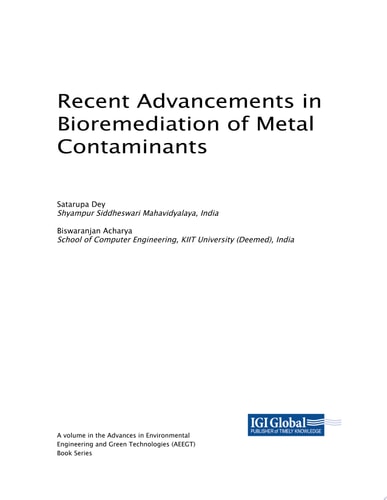
Recent Advancements in Bioremediation of Metal Contaminants
0
0
As an Amazon Associate and affiliate partner, Menrva Books earns from qualifying purchases. Learn more
Author Description
Pollution and ways to combat it have become topics of great concern for researchers. One of the most important dimensions of this global crisis is wastewater, which can often become contaminated with heavy metals such as lead, mercury, and arsenic, which are released from different industrial wastes, mines, and agricultural runoff. Bioremediation of such heavy metals has been extensively studied using different groups of bacteria, fungi, and algae, and has been considered as a safer, eco-friendly, and cost-effective option for mitigation of contaminated wasteland. The toxicity of water impacts all of society, and so it is of great importance that we understand the better, cleaner, and more efficient ways of treating water. Recent Advancements in Bioremediation of Metal Contaminants is a pivotal reference source that explores bioremediation of pollutants from industrial wastes and examines the role of diverse forms of microbes in bioremediation of wastewater. Covering a broad range of topics including microorganism tolerance, phytoremediation, and fungi, the role of different extremophiles and biofilms in bioremediation are also discussed. This book is ideally designed for environmentalists, engineers, policymakers, academicians, researchers, and students in the fields of microbiology, toxicology, environmental chemistry, and soil and water science.
Menrva's Summary
THE THESIS
This book investigates the critical challenge of heavy metal contamination in wastewater and explores bioremediation as a sustainable solution. The authors address the growing global concern over pollution, specifically focusing on industrial wastes, mines, and agricultural runoff that introduce toxic metals like lead, mercury, and arsenic into water systems. It examines the extensive research into using bacteria, fungi, and algae for bioremediation, presenting this approach as a safer, eco-friendly, and cost-effective alternative to traditional methods. The text aims to provide a comprehensive overview of recent advancements in treating contaminated water, highlighting the importance of understanding microbial roles and tolerance mechanisms.
THE SCOPE MAP
- Exploration of bioremediation techniques for heavy metal pollutants from industrial wastes.
- Discussion on the role of diverse microbial groups (bacteria, fungi, algae) in wastewater treatment.
- Coverage of microorganism tolerance mechanisms to heavy metals.
- In-depth analysis of phytoremediation strategies.
- Examination of the role of extremophiles in bioremediation processes.
- Discussion on the significance of biofilms in bioremediation.
- Focus on lead, mercury, and arsenic contamination.
THE AUTHORITY PERSPECTIVE
The book is positioned as a pivotal reference source for understanding the bioremediation of pollutants, particularly heavy metals in wastewater. It aims to serve environmentalists, engineers, policymakers, academicians, researchers, and students by consolidating knowledge on microorganism tolerance, phytoremediation, and the functions of extremophiles and biofilms. The content is structured to provide insights into cleaner and more efficient water treatment methods, addressing a significant environmental crisis.
Page Count:
363
Publication Date:
2020-07-10
Publisher:
IGI Global
ISBN-10:
1799848892
ISBN-13:
9781799848899
Science
Non-Fiction
Biotechnology
Microbiology
Heavy metals
Community Tags
Similar Books