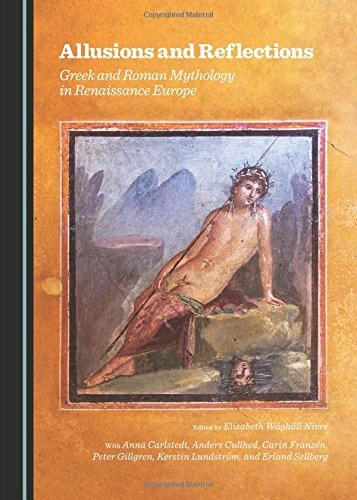
Allusions and Reflections Greek and Roman Mythology in Renaissance Europe
0
0
As an Amazon Associate and affiliate partner, Menrva Books earns from qualifying purchases. Learn more
Author Description
In June 2012, scholars from a number of disciplines and countries gathered in Stockholm to discuss the representation of ancient mythology in Renaissance Europe. This symposium was an opportunity for the participants to cross disciplinary borders and to problematize a well-researched field. The aim was to move beyond a view of mythology as mere propaganda in order to promote an understanding of ancient tales and fables as contemporary means to explain and comprehend the Early Modern world. With the Renaissance, pagan religion ceased to pose a threat to Christianity and its mythologies found a way to coexist with Christian doctrine. Old Greek and Roman tales came to play a crucial role in Renaissance culture, partly because the ancient sources, both literary and artistic, many of them recently uncovered, provided rich material for the writers and artists of the period. Mythology provided a network of allusions and references for contemporary poetry and art, reinforcing the possibilities of allegorical interpretation. Furthermore, it offered moral guidance since deities could easily be materialized into personifications of vices and virtues. All artistic expressions, visual and textual, whether they belonged to a secular or a religious tradition, made use of mythology. This volume exemplifies how Renaissance writersâ (TM) and artistsâ (TM) acquaintance with mythological accounts from Homer to Apuleius was of utmost importance for their creative work, as it was for their readers and those contemporary patrons of art who saw themselves as the living embodiment of some remote ancient deity. By posing new questions and suggesting alternative answers to old ones, the contributors to this volume provide a better and more detailed understanding of the struggles and strategies of recycling, recuperating and transforming ancient mythology during the Renaissance. All chapters here have a common focus on the re-configuration of classical myths in Early Modern Europe, in po
Page Count:
488
Publication Date:
2015-01-01
Publisher:
Cambridge Scholars Publishing
ISBN-10:
144387454X
ISBN-13:
9781443874540
Community Tags
Reader Comments
Share Your Thoughts
No comments yet. Be the first to share your thoughts!