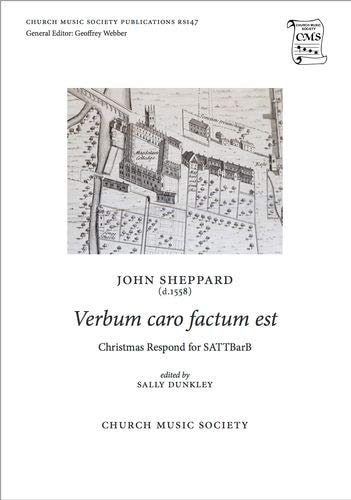
Verbum caro factum est
0
0
As an Amazon Associate and affiliate partner, Menrva Books earns from qualifying purchases. Learn more
Author Description
Product Description John Sheppard's Verbum caro factum est is perhaps the most magnificent of his Responds, as befits its Christmas context. The music alternates between polyphony and plainchant, and the text is one that lies at the very heart of the Christmas story: “The Word was made flesh and dwelt among us”.The polyphony is scored for SATTBarB, covering a span of over three octaves, and in the final chord the top voice divides into three parts. About the Author John Sheppard (c.1515-c.1558) was an English composer, much of whose life is unknown. His birth date is estimated from Sheppard's own claim in 1554 that he had been composing for twenty years. Much of Sheppard's music has been lost, with his works mostly surviving in two partbooks at Christ Church, Oxford, copied in the 1570s. Sheppard's life spanned a turbulent period in England's political and religious history: his Latin compositions are datable from their style to the reign of the Catholic Queen Mary; his much smaller English output was likely composed during the reign of the Protestant King Edward VI, though his famous Second Service may date from the very start of Elizabeth I's reign. Sheppard is buried at St Margaret's Church, Westminster.
Menrva's Summary
THE THESIS
This work investigates the structural and liturgical significance of John Sheppard’s choral respond, Verbum caro factum est, within the context of 16th-century English sacred music. The author, a historical musicologist, examines the composition's technical requirements and its place in the broader canon of Tudor-era polyphony. By analyzing the interplay between plainchant and polyphonic textures, the text provides a framework for understanding how Sheppard utilized vocal ranges and harmonic density to convey theological narratives.
THE SCOPE MAP
What You Will Find
- Detailed analysis of the SATTBarB vocal scoring and range requirements.
- Examination of the liturgical function of the respond during the Christmas season.
- Technical breakdown of the alternation between plainchant and polyphonic sections.
- Historical context regarding the preservation of Sheppard's works in Christ Church, Oxford partbooks.
THE AUTHORITY PERSPECTIVE
Musicologists and choral directors frequently cite this edition as a primary resource for performing Sheppard’s complex polyphonic works. Experts highlight the clarity of the editorial notes, which assist performers in navigating the specific vocal demands of the Tudor period.
Page Count:
12
Publication Date:
2020-11-13
Publisher:
Oxford University Press
ISBN-10:
0193954230
ISBN-13:
9780193954236
Music
Sheet Music
Choral Music
Religious Music
Musical Genres
Songbooks
Community Tags
Similar Books