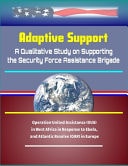
Adaptive Support: A Qualitative Study on Supporting the Security Force Assistance Brigade - Operation United Assistance (OUA) in West Africa in Response to Ebola, and Atlantic Resolve (OAR) in Europe
0
0
As an Amazon Associate and affiliate partner, Menrva Books earns from qualifying purchases. Learn more
Author Description
This study investigates the creation of the Security Force Assistance Brigades (SFAB) and analyzes how the Army can provide effective support to the unit's mission. This is significant due to the absence of current academic research pertaining to the SFAB. The intent of this research is to identify the sustainment challenges that the SFAB may encounter and present possible solutions for the Army to overcome them. In order to understand how to provide effective support, this study explains the SFAB mission, force structure, and the operational environments where SFA forces will doctrinally be employed. A qualitative research methodology is used to analyze this data through a collective case study design. The two case studies selected for this research represent the two types of operational environments where the SFAB will be employed and uses an embedded analysis to identify the sustainment challenges in each. The end result is a comprehensive understanding of the SFAB, the sustainment challenges that the unit will encounter, and possible solutions for overcoming them.This compilation also includes a reproduction of the 2019 Worldwide Threat Assessment of the U.S. Intelligence Community.The American people expect the military to be ready to respond to future challenges while being stewards of the resources given to them. Because of this, military leaders are constantly balancing "what they want to do" with "what they must do." The Budget Control Act of 2011 significantly reduced the force structure of the Army (U.S. Congress 2011). Leaders have to think critically in order to ensure that the Army is effectively and efficiently using its limited resources. According to the Atlantic Council, a U.S. policy think tank, "an adverse effect [of using Brigade Combat Teams (BCT) for Security Force Assistance (SFA), is that] it creates temporary makeshift organization with limited skills for this vital and complex long-term missions, and it destroys the readiness of the entire
Menrva's Summary
THE THESIS
This study investigates the creation and support of Security Force Assistance Brigades (SFABs) within the U.S. Army. It analyzes the challenges encountered during Operation United Assistance in West Africa and Operation Atlantic Resolve in Europe, aiming to identify sustainment issues and propose solutions for effective Army support. The research employs a qualitative methodology using a collective case study design to examine the SFAB mission, force structure, and operational environments.
THE SCOPE MAP
- Analysis of the creation and purpose of Security Force Assistance Brigades (SFABs).
- Examination of sustainment challenges faced by SFABs during Operation United Assistance (West Africa) and Operation Atlantic Resolve (Europe).
- Explanation of SFAB mission, force structure, and doctrinal employment environments.
- Qualitative research methodology utilizing a collective case study design.
- Embedded analysis of sustainment challenges within two distinct operational environments.
- Identification of potential solutions for the Army to overcome SFAB sustainment issues.
- Reproduction of the 2019 Worldwide Threat Assessment of the U.S. Intelligence Community.
THE AUTHORITY PERSPECTIVE
This work appears to be a specialized military study focused on the operational and logistical aspects of Security Force Assistance Brigades. The existing description highlights its aim to fill a gap in academic research concerning SFABs and offers practical solutions for sustainment challenges. The inclusion of the 2019 Worldwide Threat Assessment suggests a broader context of national security and resource management. The methodology points to a rigorous, data-driven analysis of real-world operations.
Page Count:
82
Publication Date:
2019-11-03
Publisher:
Independently Published
ISBN-10:
1704833582
ISBN-13:
9781704833583
Politics
Non-Fiction
History
Military Science
Intelligence
Case studies
Logistics
Security Studies
West Africa
Europe
Community Tags
Similar Books










Reader Comments
Share Your Thoughts
No comments yet. Be the first to share your thoughts!