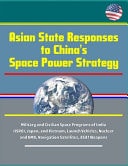
Asian State Responses to China's Space Power Strategy: Military and Civilian Space Programs of India (ISRO), Japan, and Vietnam, Launch Vehicles, Nuclear and BMD, Navigation Satellites, ASAT Weapons
0
0
As an Amazon Associate and affiliate partner, Menrva Books earns from qualifying purchases. Learn more
Author Description
China's rise as a space power has coincided with its quest for hegemony in the Indo-Pacific. Advances in China's space capabilities constitute a threat to regional states' national security, economic competitiveness, and national prestige. Accordingly, regional space powers have revised their strategies to better compete with China. This thesis examines Japan's, India's, and Vietnam's renewed approaches to space power and space security amidst China's rise. Shifts in military, commercial, and civil space policy are examined among the selected case studies. This thesis finds that Asian states are departing from historical norms by employing militarized space assets to counter the security threat from China. They are also allowing the private sector to play a larger role in their commercial space industry to improve efficiency, innovative capacity, and diplomatic outreach. Bilateral and multilateral cooperation, as well as investments in techno-nationalist space-science projects, also supplement the renewed soft-power response to Chinese space diplomacy. This thesis presents policy prescriptions for the United States to capitalize on the increasing degree of alignment among regional space powers' strategic interests. Recommendations include enhanced military-to-military relations, relaxation of commercial restrictions, and increased cooperation in civil space to balance against China.This compilation includes a reproduction of the 2019 Worldwide Threat Assessment of the U.S. Intelligence Community.Asian states are growing increasingly concerned over China's growing space capabilities and are devoting renewed attention to their respective space security strategies in response. Demonstrations such as China's 2003 manned Shenzhou V launch and 2007 anti-satellite (ASAT) test have triggered varying responses from Asian states that perceive these growing space capabilities as threats to national security and regional stability. Though existing research has delved into how A
Menrva's Summary
THE THESIS
investigates how Asian states are revising their space power strategies in response to China's growing capabilities and its pursuit of regional hegemony.** The author, Benjamin Smart from the U.S. Department of Defense, examines the military, commercial, and civil space policies of Japan, India, and Vietnam. The analysis reveals a trend towards militarized space assets and increased private sector involvement to counter security threats and enhance efficiency. Furthermore, the book explores how these nations are leveraging bilateral and multilateral cooperation, alongside techno-nationalist projects, to bolster their soft power and diplomatic outreach against China's space diplomacy.
THE SCOPE MAP
- Analysis of China's rise as a space power and its implications for Indo-Pacific hegemony.
- Examination of Japan's revised military, commercial, and civil space policies.
- In-depth study of India's ISRO and its strategic space initiatives.
- Assessment of Vietnam's evolving space security strategy.
- Discussion of the role of launch vehicles, nuclear capabilities, and Ballistic Missile Defense (BMD) in regional space competition.
- Coverage of navigation satellites and Anti-Satellite (ASAT) weapons as strategic assets.
- Policy prescriptions for the United States to align with regional space powers against China.
- Inclusion of the 2019 Worldwide Threat Assessment of the U.S. Intelligence Community.
THE AUTHORITY PERSPECTIVE
This thesis presents a detailed analysis of how key Asian nations are adapting their space strategies in the face of China's expanding space power. The work highlights a significant shift towards militarization and private sector integration within these countries' space programs. It also offers concrete policy recommendations for the United States, suggesting avenues for enhanced cooperation and strategic alignment with regional partners to balance against China's influence. The inclusion of the 2019 Worldwide Threat Assessment provides valuable context for understanding the broader geopolitical landscape.
Page Count:
122
Publication Date:
2019-09-03
Publisher:
Independently Published
ISBN-10:
1690637129
ISBN-13:
9781690637127
Science & Technology
Politics
Non-Fiction
Geopolitics
International relations
National security
Space Policy
Asian Studies
Military Technology
Community Tags
Similar Books









Reader Comments
Share Your Thoughts
No comments yet. Be the first to share your thoughts!