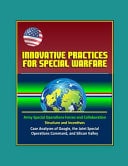
Innovative Practices for Special Warfare: Army Special Operations Forces and Collaboration, Structure and Incentives, Case Analyses of Google, the Joint Special Operations Command, and Silicon Valley
0
0
As an Amazon Associate and affiliate partner, Menrva Books earns from qualifying purchases. Learn more
Author Description
Special Warfare forces are tasked with conducting operations in uncertain environments defined by rapidly changing environmental elements (instability) and the interaction of many diverse external factors (complexity). In order to succeed, organizations operating in uncertain environments should decentralize decision making to the appropriate level and emphasize an "organic" approach that focuses on the importance of people, adaptation, and innovation. The current USASOC bureaucracy, mirroring the conventional Army, is built to maximize internal efficiency and specialize in previously predicted scenarios. Due to persistently high operational tempo, personnel downsizing, and fiscal constraints, redesigning USASOC is not feasible at this time. However, the improvement of processes and incremental enhancement to align better with the operational environment within the existing design is possible. This study explores best practices from innovative and adaptive organizations that ARSOF can draw upon to increase its capability to conduct special warfare. Through the examination of these best practices, the study identified four key factors that lead to innovation: collaboration, organizational structure, incentives, and acceptance. This study recommends that Special Warfare forces apply these factors by increasing career flexibility, internal and external linkages through broadening opportunities and liaisons, and the collective intelligence of the organization through the use of cross-functional teams and increased communication measures. Adopting these enhancements may promote innovation and adaptation and increase Special Warfare forces' contributions to national defense. CHAPTER I - FRAMING THE PROBLEM * A. INTRODUCTION * B. DESIGN PRINCIPLES FOR SPECIAL WARFARE * C. ARSOF ORGANIZATIONAL DESIGN AND INCOMPATIBILITIES WITH SPECIAL WARFARE * D. RESEARCH QUESTION * E. METHODS * CHAPTER II - LITERATURE REVIEW * A. INTRODUCTION * B. ORGANIZATIONAL DESIGN THEORY * C. IDEA DE
Menrva's Summary
THE THESIS
This study investigates how Special Warfare forces can enhance their adaptability and innovation in complex, uncertain environments by examining best practices from leading adaptive organizations. The current U.S. Army Special Operations Forces (ARSOF) bureaucracy is optimized for internal efficiency and predictable scenarios, making radical redesign infeasible due to operational tempo, personnel, and fiscal constraints. This research explores how ARSOF can improve processes and incrementally adapt within its existing structure by drawing lessons from organizations like Google and the Joint Special Operations Command. It identifies four key factors for innovation: collaboration, organizational structure, incentives, and acceptance, recommending specific enhancements to ARSOF's processes to foster these elements and increase contributions to national defense.
THE SCOPE MAP
- Analysis of organizational design principles for special warfare in uncertain and complex environments.
- Examination of the incompatibilities between current ARSOF organizational design and the demands of special warfare.
- Literature review covering organizational design theory and the generation of ideas.
- Case studies of Google, the Joint Special Operations Command, and Silicon Valley to identify innovation drivers.
- Identification of four key factors leading to innovation: collaboration, organizational structure, incentives, and acceptance.
- Recommendations for increasing career flexibility and broadening opportunities and liaisons.
- Suggestions for enhancing collective intelligence through cross-functional teams and improved communication measures.
THE AUTHORITY PERSPECTIVE
This study, originating from the Department of Defense, offers a strategic analysis of organizational adaptation for Special Warfare forces. It leverages case studies from both military and private sectors, such as Google and the Joint Special Operations Command, to propose actionable improvements. The research focuses on practical enhancements within existing structures rather than radical redesigns, aiming to boost innovation and adaptability. The findings suggest that by focusing on collaboration, structure, incentives, and acceptance, ARSOF can better meet the challenges of complex operational environments and contribute more effectively to national defense.
Page Count:
96
Publication Date:
2017-09-09
Publisher:
Amazon Digital Services LLC - KDP Print US
ISBN-10:
1549706551
ISBN-13:
9781549706554
Non-Fiction
History
Business
Military Science
Business strategy
Government
Organizational Theory
National security
Community Tags
Similar Books











Reader Comments
Share Your Thoughts
No comments yet. Be the first to share your thoughts!