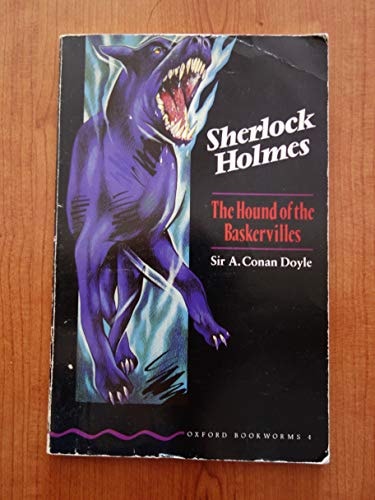
The Hound of the Baskervilles: Oxford Bookworms 4
0
0
As an Amazon Associate and affiliate partner, Menrva Books earns from qualifying purchases. Learn more
Author Description
"Oxford Bookworms" offer students at all levels the opportunity to extend their reading and appreciation of English. There are six stages, taking students from elementary to advanced level. At the lower stages, many of the texts have been specially written for the series, to provide elementary and lower-intermediate students with an introduction to real reading in English. At the higher stages, most of the books have been adapted from works originally published for native speakers. The language controls used in "Oxford Bookworms" are based on a syllabus specially created for the series by Tricia Hedge. This takes account of the more traditional approaches to grading and recent research into the nature of reading difficulty. The approximate vocabulary count for each stage Stage 1 - 400 words; Stage 2 - 700 words; Stage 3 - 1000 words; Stage 4 - 1400 words; Stage 5 - 1800 words; Stage 6 - 2500 words. All stages have exercises for classroom or private use, plus a supporting glossary to help students with vocabulary. Illustrations are used, especially at the lower stages, to help comprehension.
Menrva's Summary
THE PULSE
Sherlock Holmes and Dr. Watson investigate the mysterious death of Sir Charles Baskerville, who is rumored to have been killed by a supernatural hound haunting his family estate. Tasked with protecting the heir, Sir Henry Baskerville, the duo navigates the treacherous, fog-laden landscape of Dartmoor. They must apply rigorous logic to separate local superstition from a calculated human threat. The narrative follows a classic investigative framework, alternating between the observations of Dr. Watson and the deductive insights of Holmes. The story operates under the constraints of Victorian-era social norms and the physical isolation of the moor.
INSIDE THE PAGES
- Atmospheric setting of the desolate Dartmoor landscape
- Dual-perspective narrative structure focusing on Watson's observations
- Systematic application of deductive reasoning to solve a crime
- Exploration of the tension between folklore and scientific reality
- Character study of the contrast between Holmes's intellect and Watson's empathy
- Pacing designed for language learners with controlled vocabulary
- Inclusion of comprehension exercises for educational reinforcement
- Supporting glossary to assist with advanced or archaic terminology
THE COLLECTIVE ECHO
Readers frequently highlight this adaptation as an accessible entry point into the classic detective genre for non-native English speakers. Discussion often centers on how the simplified language maintains the suspenseful atmosphere of the original Arthur Conan Doyle text. Critics note that the inclusion of pedagogical tools, such as glossaries and exercises, effectively bridges the gap between basic reading skills and complex literary themes. The balance between character development and the central mystery remains intact, providing a clear example of how classic literature can be adapted without losing its core narrative tension.
Page Count:
96
Publication Date:
1989-01-01
Publisher:
Oxford University Press España, S.A.
ISBN-10:
0194216330
ISBN-13:
9780194216333
Mystery
classic
Adaptation
Detective
Educational
Community Tags
Similar Books