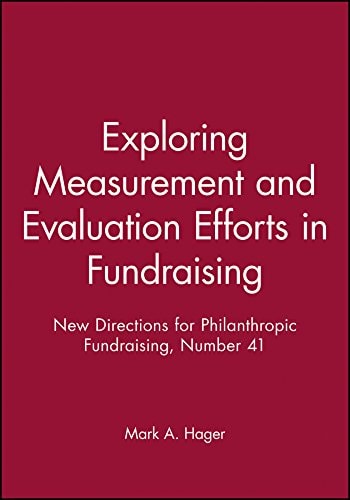
Exploring Measurement and Evaluation Efforts in Fundraising: New Directions for Philanthropic Fundraising, Number 41
0
0
As an Amazon Associate and affiliate partner, Menrva Books earns from qualifying purchases. Learn more
Author Description
This issue addresses a variety of issues regarding the measurement and evaluation of fundraising costs and activities. Topics examined include watchdog groups and the effect of their ratings on public perceptions; emerging data on workplace solicitation of federal employees; and summary results from a national study of nonprofit fundraising and administrative costs. Contributors present innovative concepts such as a vision for using the price of outcomes to encourage funder support of particular social service delivery programs as well as cautionary satire against using simple ratios to gauge fundraising efficiency that can mask the "ill-intentioned fundraising abusers" who place profit above mission. The culminating chapter presents the findings of a trio of nonprofit accounting professors who analyze professional fundraising firms, demonstrating that solicitation firms often keep most of the contributions in most campaigns. Taken together, the chapters reflect three major themes in evaluation and measurement of fundraising today. First, research on fundraising has the definite benefit of teaching students of the field what the field looks like. Secondly, the issue’s contributors explore the quality of information we have when we seek to measure and evaluate charities and their fundraising activities. Finally, this issue sheds a much-needed light on the kinds of decisions people make from evaluation of fundraising and argues that the result is that the bottom line and financial efficiency have become the measures by which we assess charities in the United States. This is the 100th issue of the Jossey-Bass quarterly journal New Directions for Philanthropic Fundraising.
Menrva's Summary
THE THESIS
This collection critically examines the multifaceted landscape of fundraising measurement and evaluation, challenging conventional metrics and highlighting the complexities of assessing charitable effectiveness. The issue delves into the influence of watchdog groups on public perception, presents data on workplace solicitations, and analyzes national studies on nonprofit fundraising and administrative costs. Contributors introduce novel concepts like valuing outcomes to guide funder support and caution against over-reliance on simple efficiency ratios that can obscure unethical practices. The work collectively explores the benefits of research for students of the field, the quality of information available for evaluating charities, and the concerning trend of prioritizing financial efficiency over mission in the United States.
THE SCOPE MAP
- Analysis of watchdog groups and their impact on public perception of charities.
- Emerging data on workplace solicitation of federal employees.
- Summary results from a national study on nonprofit fundraising and administrative costs.
- Exploration of using the price of outcomes to encourage funder support.
- Critique of simple ratios for gauging fundraising efficiency and their potential to mask abuses.
- Analysis of professional fundraising firms and their contribution retention rates.
- Discussion on the quality of information available for evaluating charities.
- Examination of the trend towards assessing charities based on financial efficiency.
THE AUTHORITY PERSPECTIVE
This collection is regarded as a significant contribution to the field of philanthropic fundraising, offering a critical look at how charitable efforts are measured and evaluated. The chapters collectively address the need for more nuanced approaches beyond simple financial ratios, highlighting how such metrics can sometimes obscure the true impact and mission of organizations. The research presented provides valuable insights for students and practitioners alike, prompting a re-evaluation of how charities are assessed in the United States, particularly concerning the balance between financial efficiency and programmatic outcomes. The contributors' diverse perspectives underscore the ongoing debate about the best methods for ensuring accountability and effectiveness in the nonprofit sector.
Page Count:
112
Publication Date:
2004-01-19
Publisher:
Jossey-Bass
ISBN-10:
0787972703
ISBN-13:
9780787972707
Non-Fiction
Business
Philanthropy
Evaluation
Fundraising
Charity
Community Tags
Similar Books