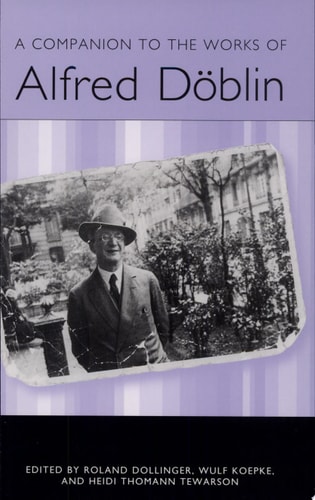
A Companion to the Works of Alfred Döblin
0
0
As an Amazon Associate and affiliate partner, Menrva Books earns from qualifying purchases. Learn more
Author Description
Alfred Döblin (1878-1957) was one of the great German-Jewish writers of the 20th century, a major figure in the German avant-garde before the First World War and a leading intellectual during the Weimar Republic. Döblin greatly influenced the history of the German novel: his best-known work, the best-selling 1929 novel Berlin Alexanderplatz, has frequently been compared in its use of internal monologue and literary montage to James Joyce's Ulysses and John Dos Passos's Manhattan Transfer. Döblin's oeuvre is by no means limited to novels, but in this genre, he offered a surprising variety of narrative techniques, themes, structures, and outlooks. Döblin's impact on German writers after the Second World War was considerable: Günter Grass, for example, acknowledged him as "my teacher." And yet, while Alexanderplatz continues to fascinate the reading public, it has overshadowed the rest of Döblin's immense oeuvre. This volume of carefully focused essays seeks to do justice to such important texts as Döblin's early stories, his numerous other novels, his political, philosophical, medical, autobiographical, and religious essays, his experimental plays, and his writings on the new media of cinema and radio. Contributors:Heidi Thomann Tewarson, David Dollenmayer, Neil H. Donahue, Roland Dollinger, Veronika Fuechtner, Gabriele Sander, Erich Kleinschmidt, Wulf Koepke, Helmut F. Pfanner, Helmuth Kiesel, Klaus Müller-Salget, Christoph Bartscherer, Wolfgang Düsing. Roland Dollinger is associate professor of German at Sarah Lawrence College; Wulf Koepke is professor emeritus of German at Texas A&M University; Heidi Thomann Tewarson is professor of German at Oberlin College.
Page Count:
309
Publication Date:
2004-01-01
Publisher:
Camden House
ISBN-10:
1571131248
ISBN-13:
9781571131249