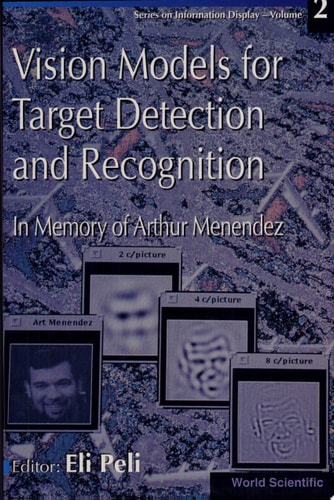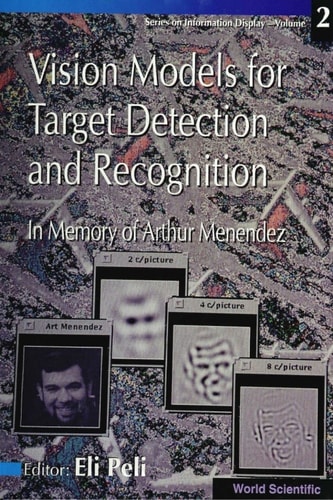
Vision Models for Target Detection and Recognition (V2)
0
0
As an Amazon Associate and affiliate partner, Menrva Books earns from qualifying purchases. Learn more
Author Description
This book is an international collection of contributions from academia, industry and the armed forces. It addresses current and emerging Spatial Vision Models and their application to the understanding, prediction and evaluation of the tasks of target detection and recognition. The discussion in many of the chapters is framed in terms of military targets and military vision aids. However, the techniques analyses and problems are by no means limited to this area of application. The detection and recognition of an armored vehicle from a reconnaissance image are performed by the same visual system used to detect and recognize a tumor in an X-ray. The analysis of the interaction of the human visual system with night vision devices is not different from the analysis needed in the case of an operator examining structures using a remote (endoscopic) camera, etc. The book is organized into three general sections. The first covers basic modeling of central (foveal) vision and its theoretical background. The second is centered on the evaluation of model performance in applications, while the third is dedicated to aspects of peripheral vision modeling and the expansion of peripheral modeling to include visual search.
Menrva's Summary
THE THESIS
This book investigates the application of spatial vision models to target detection and recognition across various domains. It presents a collection of contributions from academia, industry, and the armed forces, focusing on current and emerging models. While many chapters frame discussions within military contexts, the underlying techniques are broadly applicable to diverse fields such as medical imaging and remote sensing. The book aims to provide a comprehensive understanding of how visual systems process information for identification tasks.
THE SCOPE MAP
- Foundational modeling of central (foveal) vision and its theoretical underpinnings.
- Evaluation methodologies for model performance in practical applications.
- Detailed analysis of peripheral vision modeling.
- Expansion of peripheral modeling to encompass visual search strategies.
- Case studies and examples from military and civilian applications.
- Discussion of techniques applicable to image analysis and remote sensing.
THE AUTHORITY PERSPECTIVE
The book is structured into three main sections, progressing from fundamental vision modeling to performance evaluation and then to peripheral vision and visual search. The contributions span academic, industrial, and military perspectives, highlighting the broad applicability of spatial vision models beyond their military-centric examples. The techniques discussed are relevant for understanding how visual systems perform detection and recognition tasks in diverse scenarios, from identifying armored vehicles to recognizing tumors in X-rays. This comprehensive approach suggests a text valuable for researchers and practitioners in computer vision, artificial intelligence, and human factors.
Page Count:
1423
Publication Date:
1995-05-31
Publisher:
World Scientific Publishing
ISBN-10:
9812831207
ISBN-13:
9789812831200
Science
Non-Fiction
Human Factors
Image Processing
Military Applications
Computer Vision
Community Tags
Similar Books