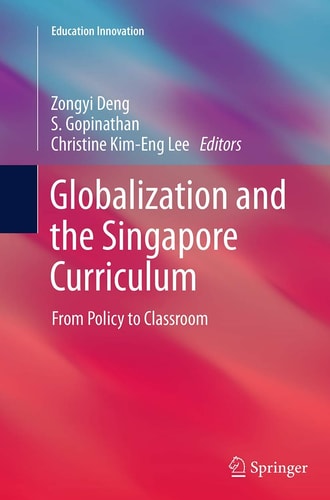
Globalization and the Singapore Curriculum: From Policy to Classroom
0
0
As an Amazon Associate and affiliate partner, Menrva Books earns from qualifying purchases. Learn more
Author Description
This volume provides a multi-faceted and critical analysis of the Singapore curriculum in relation to globalization. First, it details reform initiatives established by the Singapore government to meet the challenges posed by globalization. Next, Globalization and the Singapore Curriculum presents how these reforms have been translated into programs, school subjects and operational frameworks and then examines, in turn, how well these have been implemented in schools and classrooms across the country. Through this examination, the book reveals how the initiatives, together with their curricular translation and classroom enactment, reflect on the one hand global features and tendencies and, on the other, distinct national traditions, concerns and practices. It brings to light a set of issues, problems and challenges that not only concern policymakers, educators and reformers in Singapore but also those in other countries as well. Written by curriculum scholars, policy analysts, researchers and teacher educators, Globalization and the Singapore Curriculum offers an up-to-date reference for postgraduate students, scholars and researchers in the areas of curriculum and instruction, comparative education, educational sociology, educational policy and leadership in Singapore, the Asia Pacific region and beyond. It also offers a vital contribution to the story of modern education around the globe: providing international students, scholars and researchers valuable insights into curriculum and curriculum reform for the 21st century.
Menrva's Summary
THE THESIS
This volume critically analyzes the Singapore curriculum's adaptation to globalization, examining policy initiatives, their translation into educational programs, and their implementation in classrooms. Authored by a team of curriculum scholars, policy analysts, researchers, and teacher educators, the book details the Singapore government's reform efforts designed to address global challenges. It then investigates how these reforms manifest in school subjects and operational frameworks, assessing their effectiveness in actual classroom settings. The analysis reveals the interplay between global trends and distinct national traditions, highlighting issues relevant to policymakers and educators worldwide.
THE SCOPE MAP
- Analysis of Singaporean government reform initiatives in response to globalization.
- Examination of how reforms are translated into educational programs, subjects, and frameworks.
- Assessment of the implementation of these reforms in schools and classrooms.
- Exploration of the reflection of global features and national traditions in curriculum and practice.
- Identification of issues, problems, and challenges for policymakers and educators.
- Insights into curriculum and curriculum reform for the 21st century.
THE AUTHORITY PERSPECTIVE
The book is presented as an up-to-date reference for postgraduate students, scholars, and researchers in curriculum and instruction, comparative education, educational sociology, and educational policy and leadership. Its contribution is framed as providing valuable insights into curriculum and curriculum reform for the 21st century, relevant to Singapore, the Asia Pacific region, and beyond. The authors, a collective of experts, aim to offer a multi-faceted and critical analysis of the subject matter. The work is positioned to inform both national and international perspectives on educational adaptation in a globalized world.
Page Count:
279
Publication Date:
2016-09-18
Publisher:
Springer Nature Singapore
ISBN-10:
9811011605
ISBN-13:
9789811011603
History
Non-Fiction
Politics
Policy
Sociology
Education
Community Tags
Similar Books