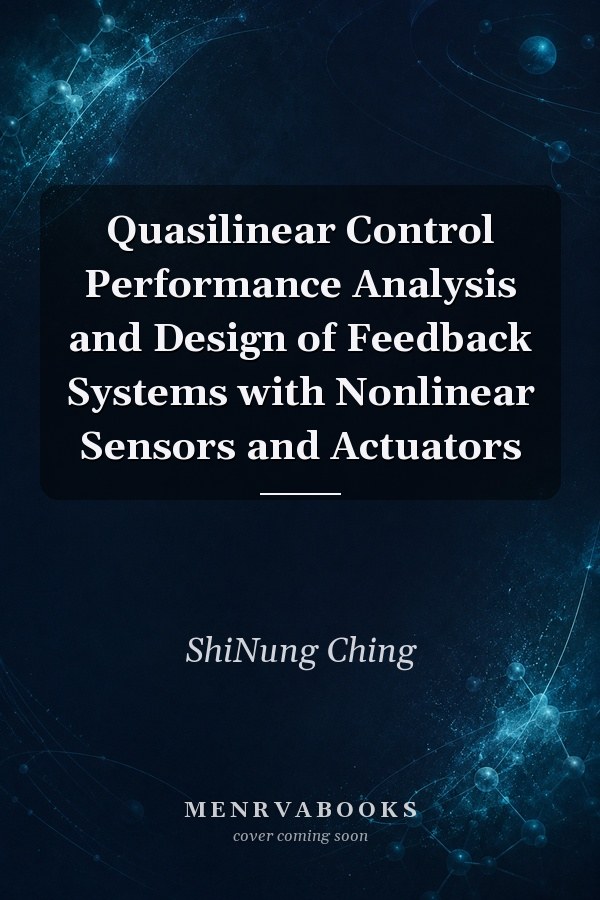
Quasilinear Control Performance Analysis and Design of Feedback Systems with Nonlinear Sensors and Actuators
0
0
As an Amazon Associate and affiliate partner, Menrva Books earns from qualifying purchases. Learn more
Author Description
This is a textbook and reference for readers interested in quasilinear control (QLC). QLC is a set of methods for performance analysis and design of linear plant or nonlinear instrumentation (LPNI) systems. The approach of QLC is based on the method of stochastic linearization, which reduces the nonlinearities of actuators and sensors to quasilinear gains. Unlike the usual Jacobian linearization stochastic linearization is global. Using this approximation, QLC extends most of the linear control theory techniques to LPNI systems. A bisection algorithm for solving these equations is provided. In addition, QLC includes new problems, specific for the LPNI scenario. Examples include Instrumented LQR/LQG, in which the controller is designed simultaneously with the actuator and sensor, and partial and complete performance recovery, in which the degradation of linear performance is either contained by selecting the right instrumentation or completely eliminated by the controller boosting.
Menrva's Summary
THE THESIS
This book analyzes the performance and design of feedback control systems, specifically addressing the complexities introduced by nonlinear sensors and actuators. The authors present Quasilinear Control (QLC), a methodology for analyzing and designing Linear Plant/Nonlinear Instrumentation (LPNI) systems. QLC employs stochastic linearization to approximate nonlinear components with quasilinear gains, offering a global approximation unlike Jacobian linearization. This approach enables the extension of most linear control theory techniques to LPNI systems, providing a robust framework for advanced control applications.
THE SCOPE MAP
- Methods for performance analysis and design of quasilinear control (QLC) systems.
- Application of stochastic linearization to reduce nonlinearities in actuators and sensors to quasilinear gains.
- Extension of linear control theory techniques to Linear Plant/Nonlinear Instrumentation (LPNI) systems.
- A bisection algorithm for solving QLC equations.
- New problems specific to the LPNI scenario, including Instrumented LQR/LQG.
- Techniques for partial and complete performance recovery by managing instrumentation and controller boosting.
THE AUTHORITY PERSPECTIVE
This textbook and reference provides a comprehensive exploration of Quasilinear Control (QLC) methods for systems with nonlinear sensors and actuators. The approach is noted for its global approximation via stochastic linearization, distinguishing it from Jacobian linearization. The text is structured to extend linear control theory to LPNI systems and includes practical algorithms and specific problem formulations like Instrumented LQR/LQG. The content is geared towards readers interested in advanced control engineering and systems analysis.
Page Count:
301
Publication Date:
2014-05-14
Publisher:
Cambridge University Press
ISBN-10:
1139190652
ISBN-13:
9781139190657
Science
Non-Fiction
Engineering
Robotics
Control Theory
Electrical Engineering
Community Tags
Similar Books