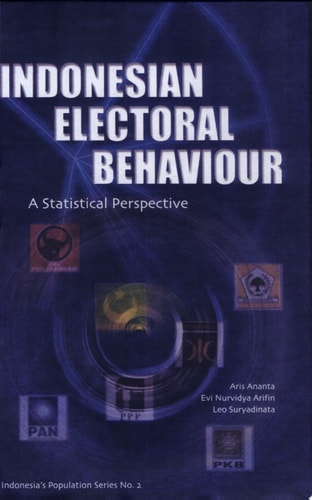
Indonesian Electoral Behaviour: A Statistical Perspective
0
0
As an Amazon Associate and affiliate partner, Menrva Books earns from qualifying purchases. Learn more
Author Description
In Indonesia's plural society, ethnicity and religion are considered as independent variables to explain electoral behaviour. Many writers use qualitative methods to relate political party performance in terms of ethnicity and religion. This book questions these assumptions by looking at data on the 1999 election and the 2000 population census.
Menrva's Summary
THE THESIS
This book investigates the role of ethnicity and religion in Indonesian electoral behavior, challenging conventional qualitative assumptions with statistical analysis. The authors, Aris Ananta, Evi Nurvidya Arifin, and Leo Heng Chew Suryadinata, utilize data from the 1999 election and the 2000 population census to provide a quantitative perspective on voter choices in Indonesia's diverse society. They aim to offer a data-driven understanding of how these factors, often treated as independent variables, actually influence electoral outcomes. The study seeks to move beyond qualitative interpretations by rigorously examining statistical correlations and patterns.
THE SCOPE MAP
- Analysis of electoral behavior in Indonesia's plural society.
- Statistical examination of the influence of ethnicity and religion on voting patterns.
- Utilizes data from the 1999 Indonesian election.
- Incorporates data from the 2000 Indonesian population census.
- Challenges qualitative assumptions about ethnicity and religion as sole determinants of electoral choice.
- Presents a quantitative perspective on political party performance.
- Focuses on statistical correlations and data-driven insights.
THE AUTHORITY PERSPECTIVE
This book offers a statistically rigorous examination of electoral behavior in Indonesia, a topic often approached through qualitative lenses. By employing data from the 1999 election and the 2000 census, the authors provide a quantitative counterpoint to prevailing assumptions about the influence of ethnicity and religion. The work is likely to be of interest to academics and researchers specializing in Indonesian politics, electoral studies, and quantitative social science methods. Its focus on statistical analysis suggests a dense, data-intensive approach to understanding voter demographics and choices.
Page Count:
429
Publication Date:
2004-01-01
Publisher:
Institute of Southeast Asian Studies
ISBN-10:
9812302271
ISBN-13:
9789812302274
Non-Fiction
Politics
Economics
Sociology
Elections
Statistics
Community Tags
Similar Books