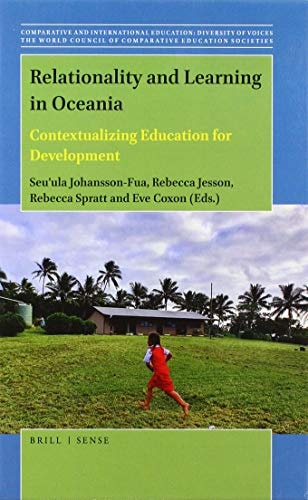
Relationality and Learning in Oceania: Contextualizing Education for Development
0
0
As an Amazon Associate and affiliate partner, Menrva Books earns from qualifying purchases. Learn more
Author Description
This multi-authored volume draws on the collective experiences of a team of researcher-practitioners, from three Oceanic universities, in an aid-funded intervention program for enhancing literacy learning in Pacific Islands primary education schools. The interventions explored here--in Solomon Islands and Tonga--were implemented via a four-year collaboration which adopted a design-based research approach to bringing about sustainable improvements in teacher and student learning, and in the delivery and evaluation of educational aid. This approach demanded that learning from the context of practice should be determining of both content and process; that all involved in the interventions should see themselves as learners. Essential to the trusting and respectful relationships required for this approach was the program's acknowledgement of relationality as central to indigenous Oceanic societies, and of education as a relational activity. Relationality and Learning in Oceania: Contextualizing Education for Development addresses debates current in both comparative education and international aid. Argued strongly is that relational research-practice approaches (south-south, south-north) which center the importance of context and culture, and the significance of indigenous epistemologies, are required to strengthen education within the post-colonial relational space of Oceania, and to inform the various agencies and actors involved in 'education for development' in Oceania and globally. Maintained is that the development of education structures and processes within the contexts explored through the chapters comprising this volume, continues to be a negotiation between the complexity of historically developed local 'traditions' and understandings and the 'global' imperatives shaped by dominant development discourses.
Menrva's Summary
THE THESIS
This volume investigates how relationality and context-specific cultural understanding are essential for effective educational development in Oceania. Drawing on the experiences of researcher-practitioners from three Oceanic universities, the book examines an aid-funded intervention program aimed at enhancing literacy learning in Pacific Islands primary schools. The authors argue that a design-based research approach, which prioritizes learning from the context of practice and acknowledges all participants as learners, is crucial for sustainable improvements. The work highlights the significance of indigenous epistemologies and relational research-practice approaches in navigating the complexities of education within post-colonial Oceania.
THE SCOPE MAP
- Case studies from intervention programs in Solomon Islands and Tonga.
- An exploration of a four-year collaboration using a design-based research approach.
- Analysis of sustainable improvements in teacher and student learning.
- Discussion on the delivery and evaluation of educational aid.
- Examination of the role of relationality in indigenous Oceanic societies.
- Consideration of the negotiation between local traditions and global development discourses in education.
THE AUTHORITY PERSPECTIVE
The book is positioned as a significant contribution to debates in comparative education and international aid, particularly concerning the post-colonial context of Oceania. It advocates for relational research-practice approaches that center context, culture, and indigenous epistemologies to strengthen education. The work is likely to be of interest to academics, policymakers, and practitioners involved in education for development in the region and globally, offering a nuanced perspective on the challenges and opportunities within this space.
Page Count:
172
Publication Date:
2020-01-01
Publisher:
Brill | Sense
ISBN-10:
9004425306
ISBN-13:
9789004425309
Politics
Non-Fiction
History
Sociology
Education
Community Tags
Similar Books



Reader Comments
Share Your Thoughts
No comments yet. Be the first to share your thoughts!